

China has never been easier to enter. Most European passports, and since February the British one, can now walk in for thirty days without a visa, a policy extended until the end of 2026. Tibet is a different story: it still needs its own permit, a licensed guide and an organised trip, and in 2026 it has had its share of closures and bad news. Here is what the rules really are, what changed this year, and how to ride the roof of the world without getting stuck at the airport in Chengdu.
The visa that disappeared
A few years ago, getting a Chinese tourist visa was a small project: forms, bookings, bank statements, a trip to a visa centre and a wait. For most Europeans, that is now history. China’s unilateral visa-free policy lets ordinary passport holders from about fifty countries enter for up to thirty days for tourism, business, family visits, exchanges or transit. It covers France, Germany, Italy, Spain, the Netherlands, Switzerland, Ireland, Hungary and most of the rest of Europe, as well as Australia and New Zealand. Sweden joined in November 2025, and the United Kingdom and Canada were added on 17 February 2026.
In November 2025, Beijing extended the policy until 31 December 2026. It has been renewed and widened several times since it began, and foreigners made more than twenty million visa-free entries into China in 2024 alone. Citizens of some countries, including the United States, are not part of the thirty-day scheme, but they can use China’s 240-hour visa-free transit policy when travelling on to a third country, which allows up to ten days in designated regions. For everyone else, a visa is still required.
And then there is Tibet
None of that changes the basic rule for Tibet. The Tibet Autonomous Region is the only part of China where foreign visitors need a special permit on top of their Chinese entry, visa or no visa. The Tibet Travel Permit is issued only to visitors who book an organised trip through a licensed agency, and it requires travel with a licensed Tibetan guide. You cannot apply for it yourself, you cannot travel independently in the region, and you cannot board a flight or a train to Lhasa without it.
The United States State Department, in its annual report to Congress on access to Tibet published in spring 2026, described the region as the only territory in China where foreign diplomats, journalists, researchers and tourists face extraordinary access restrictions requiring special permits in addition to visas. That is a political document with its own agenda, but on the practical point it is simply accurate. For a rider, the consequence is clear: Tibet is visited as part of an organised tour, or not at all.
Why the visa-free rule still helps
That does not make the visa-free policy irrelevant to Tibet. On the contrary, it removes one of the two big pieces of paperwork. A rider from France or the Netherlands no longer needs a Chinese tourist visa before travelling; they can fly into Chengdu on their passport, and the tour operator arranges the Tibet permit in the background. That takes a lot of stress, cost and waiting out of the process.
The key is the thirty-day limit. A twelve-day Tibet ride, with a day or two either side in Chengdu, fits comfortably. A longer trip combining Tibet with Yunnan or other parts of China needs careful counting, and anything beyond thirty days requires a visa in the usual way. The 240-hour transit scheme, useful as it is elsewhere, does not cover Tibet at all.
The closures that come with the calendar
Even with a permit, Tibet is not open to foreigners every day of the year. In many years, the authorities stop issuing permits to foreign tourists for several weeks around February and March, a period that includes the Tibetan New Year and politically sensitive anniversaries. The timing and length of these closures are rarely announced far in advance, and they can change from year to year. Other short closures can happen at short notice around major political events.
For riders, the lesson is simple. The best riding season in Tibet runs roughly from May to early October, when the passes are clear, the days are long and the weather on the plateau is at its kindest. Plan within that window, book early, and keep an eye on the news. A good operator will tell you immediately if a closure affects your dates.
Everest’s north side: climbers out, riders still welcome
2026 brought a surprise for the mountaineering world. The China Tibet Mountaineering Association did not open the north side of Everest to foreign climbing expeditions this spring, without explaining why, and the authorities did not start the usual application process for climbers. According to an estimate by the Everest chronicler Alan Arnette, about 125 climbers who had planned to climb from Tibet were expected to switch to the Nepali side instead.
That closure concerned climbing expeditions on the mountain itself. Visitors to the base camp area on the Tibetan side, including riders on organised tours, have been able to travel up the valley towards Rongbuk, where the famous view of the north face fills the end of the valley. Tourist access has been more restricted in recent years than it once was, with visitors stopping short of the climbers’ base camp. But the view, and the ride over the passes to get there, remain one of the great experiences of the Himalaya.
The flood that crossed the border
On 26 August 2026, a huge collapse of ice and rock from Langtang Lirung in Nepal set off a disaster that hit both sides of the border, around the Trishuli river and the frontier between Nepal’s Rasuwa district and Tibet’s Gyirong county. By 24 September, according to AFP, it had killed 1,451 people in Nepal and 43 in China, most of the latter in Gyirong county on the Tibetan side. The Gyirong border crossing, one of the main trade routes between Nepal and China and the road used by many pilgrims heading to Mount Kailash, was destroyed.
For riders, the practical consequence is that the overland route from Kathmandu into Tibet is out of action for the foreseeable future. That route was already complicated by permits and paperwork, and most Tibet trips, ours included, start from inside China anyway. But anyone who had dreamed of a Kathmandu to Lhasa ride, or a Kailash pilgrimage by road from Nepal, should put that plan aside for now.
What a Tibet ride actually looks like
Our 12-day Tibet ride starts in Chengdu, flies up to Lhasa and gives the group a day to acclimatise and see the Potala Palace before any riding begins. From there it heads to Tsedang in the Yarlung valley, the cradle of Tibetan civilisation, then over the high passes to Gyantse with its great stupa, on to Sakya and its monastery, and up towards Everest. After the Everest region, the route returns through Shigatse, heads north to the sacred lake of Namtso, and finishes back in Lhasa.
Every one of those days is ridden at altitude, most of them above 4,000 metres, with passes above 5,000, the highest at around 5,200. The roads are mostly paved and in far better condition than their reputation suggests, but the thin air, the cold mornings and the sheer scale of the landscape make every stage a serious undertaking. It is not a ride for anyone who has never been to altitude before without careful preparation.
Namtso, the last great view
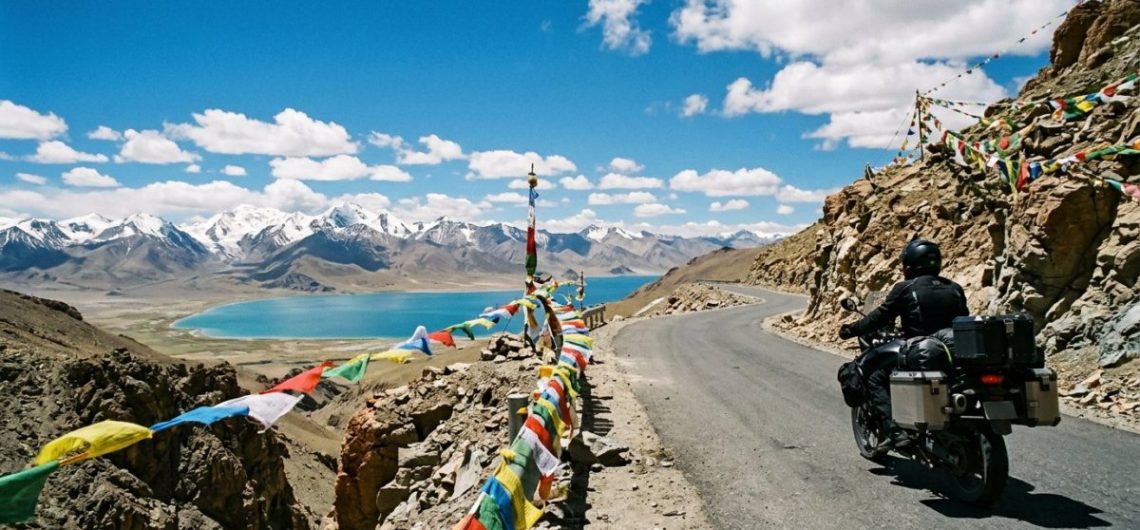
The final big day of the Tibet ride goes north from the Lhasa valley to Namtso, one of the highest large lakes in the world, at around 4,700 metres. The road climbs over a pass above 5,000 metres, strung with thousands of prayer flags cracking in the wind, and then drops towards a sheet of water so blue it looks artificial, with the snow peaks of the Nyenchen Tanglha range standing along its southern shore. Nomads graze yaks on the grassland around it, and pilgrims walk its shore as an act of devotion.
For many riders it is the moment the whole trip comes together: the altitude, the space, the light and the sense of having ridden somewhere very few people ever reach on two wheels. It is also a reminder of why the paperwork is worth it. No permit office, checkpoint or visa rule has ever made that view any less extraordinary.
Altitude: the rule that does not care about visas
Lhasa sits at about 3,650 metres, and the plateau around it rarely drops much below that. Flying straight into that height from the lowlands of Chengdu is a shock to the body, which is why every sensible Tibet itinerary starts with rest days in Lhasa before the riding begins. Headaches, breathlessness, poor sleep and loss of appetite are common in the first days. Serious altitude sickness is rarer, but it can be dangerous, and it has nothing to do with how fit you are.
Drink a lot of water, avoid alcohol for the first days, walk slowly, sleep as well as you can, and tell your guide immediately if you feel worse rather than better. On a well-run trip, there should be oxygen available and a clear plan for getting someone down quickly if needed. On a ride where the highest pass is higher than any summit in the Alps, that plan is not optional.
Lhasa before the first ride
The acclimatisation days in Lhasa are not wasted days. The Potala Palace, the former winter palace of the Dalai Lamas, rises above the city in thirteen storeys of white and red walls, and climbing its stairways slowly at 3,650 metres is a very good test of how your body is coping. The Jokhang temple, the holiest in Tibet, sits at the heart of the old town, surrounded by the Barkhor, the circuit that pilgrims walk clockwise from dawn to dusk, spinning prayer wheels and prostrating themselves on the stones.
In the afternoons, the monks of Sera monastery on the edge of the city gather in a courtyard for their famous debates, clapping and gesturing as they test each other on points of Buddhist philosophy. It is one of the most extraordinary things you can watch anywhere in Asia, and it tells you more about Tibetan culture than any museum. Visits to the main sites are organised with your guide, and photography rules vary from place to place, so ask before you raise the camera.
Checkpoints and the famous speed tickets
Riding in Tibet comes with a peculiarity that surprises everybody the first time. In recent years, on many main roads, police checkpoints have controlled not only your documents but your speed, in a very Tibetan way. At a checkpoint you receive a slip with the time you passed, and you are not allowed to reach the next checkpoint before a certain time, calculated from the distance and the speed limit. Arrive too early, and you are fined.
The result is a ritual familiar to anyone who has driven the plateau: vehicles pulled over a few kilometres before a checkpoint, drivers smoking and chatting while the clock catches up. On a motorcycle, that pause is often welcome, with a flask of butter tea and a view of a glacier. Your guide will manage the timing. Your job is to enjoy the view and remember that the rules are enforced.
Staying connected in China
One more practical point surprises visitors. Many Western apps and websites, Google and WhatsApp among them, are blocked in mainland China, and that includes Tibet. Plan in advance how you will stay in touch with home and with the group, and download the maps and documents you need before you arrive. Chinese payment apps, which dominate everyday spending, have in recent years made it possible for foreign visitors to link international cards, which makes buying a coffee or a bottle of water much easier than it used to be.
On an organised ride, the guides handle most of the day-to-day logistics, from permits to fuel and hotels. But it helps to arrive with a phone that works, a way to pay for small things and a realistic idea of what you will and will not be able to use online. A week without your usual apps on the roof of the world is not the worst thing that could happen to anybody.
Yunnan: Tibetan culture without the Tibet permit
There is another way to experience Tibetan culture in China, and it matters for riders who cannot fit the permit process into their plans. The north-west of Yunnan province, around Shangri-La and Deqen, is part of the Tibetan cultural world, with monasteries, prayer flags, snow peaks and villages that would not look out of place on the plateau. But it lies outside the Tibet Autonomous Region, so no Tibet permit is needed.
Our 20-day Tibet and Shangri-La ride takes exactly that route. It starts in Chiang Mai, crosses northern Laos, enters China and rides north through Yunnan to Dali, Lijiang, the Tiger Leaping Gorge and Shangri-La, up to Deqen near the border of the Tibet region and on to Cizhong, before heading back south through Shaxi and the tea country towards Laos. For riders from visa-free countries, the thirty-day rule helps here too, although the details for each passport and each border crossing need to be checked individually, and that check belongs at the start of the booking, not at the border.
Riding a motorcycle in China: the part people forget
One more rule applies to anyone riding in China, and it is not about visas. China does not recognise foreign driving licences or International Driving Permits for driving on its roads. Foreign riders need Chinese temporary driving permits, and foreign vehicles need temporary Chinese registration, all arranged in advance through the authorities and usually through a specialised agency. This is one of the main reasons why independent motorcycle travel in China is so rare.
On an organised ride, that paperwork is handled before you arrive, and the process on the day is usually a short visit to an office with a photo and a signature. It is still worth knowing about, because it explains why a China ride has to be booked well in advance, and why last-minute changes to the group are difficult.
What to watch for in 2027
The visa-free policy is currently valid until 31 December 2026. China has renewed and expanded it every time so far, and it clearly sees the policy as a success, so a further extension looks likely, though it is not guaranteed. But riders planning Tibet or Yunnan for next summer should check the rules again when the decision is announced, probably towards the end of this year. The same applies to Tibet’s own permit calendar, which is never published far in advance.
The good news is that the timing works in riders’ favour. The Tibet season opens in spring, well after any decision on the visa policy, and the permit is arranged a few weeks before travel. As long as you book with enough time and stay flexible about the exact dates, the paperwork is manageable. The mountains, as usual, are the easy part.
Riding Tibet for real
The 12-day Lhasa to Everest Base Camp ride starts in Chengdu and takes you from Lhasa through Gyantse and Sakya to the Everest region, then to Shigatse and Namtso, with the Tibet permit arranged, a licensed guide, acclimatisation days and a support vehicle. The 20-day Tibet and Shangri-La ride explores the Tibetan world of Yunnan from Chiang Mai via Laos. Each is a guided tour built around the rules that make Tibet and China unlike anywhere else.
Want to know whether your passport works for next season? Ask us on WhatsApp or at info@bigbiketours.com. A motorcycle tour on the roof of the world starts with paperwork, and a big biking tour with the permits handled is the easiest way to get to the part that matters: the passes, the monasteries and the thin, clear air of the highest motorbike tour you will ever ride.
 English
 Deutsch
 Español
 Français
 Italiano
Comments