

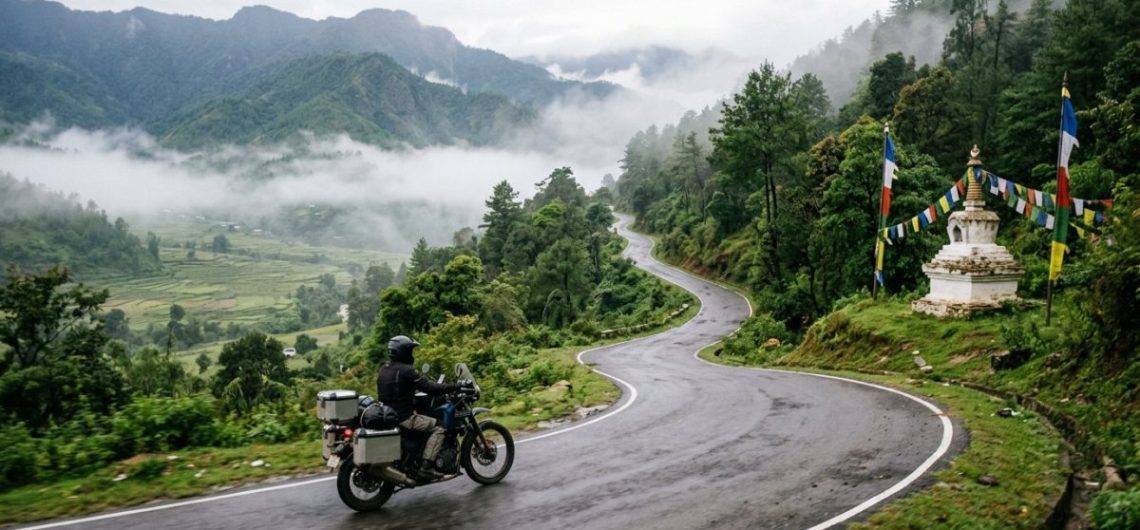
For decades, almost everyone who flew into Bhutan arrived the same way: a nerve-testing landing at Paro, in a narrow valley between mountains. Since December 2025, there is a second door. Gelephu International Airport in the south now takes scheduled flights from abroad, and 2026 has been a very strong year for visitors. Here is what is actually flying, what it could change for riders, and why the most useful news for most of us this year is somewhere else on the Drukair timetable.
A second gateway, in the south
On 8 December 2025, a Drukair Airbus took off from Gelephu, in southern Bhutan near the Indian border, and flew to Kolkata with the prime minister on board. It was the first international flight from the airport, which had received its international aerodrome certificate back in 2023. Four days later, scheduled service began: two flights a week, on Mondays and Fridays, between Gelephu and Kolkata, with an Airbus A319 of 118 seats.
The route is modest, but the symbolism is not. Gelephu is the heart of one of the most ambitious projects in the Himalaya, the Gelephu Mindfulness City, a special administrative zone planned around sustainable industries, logistics, wellness and tourism, championed by the king. The airport is meant to become its front door. A much larger new terminal and airport complex has been designed for the future, and its concept already won the Future Project of the Year title at the World Architecture Festival in 2025.
The first passengers, in plain numbers
It is worth keeping the scale in perspective. In the first month of scheduled operations, thirty-eight passengers flew from Gelephu to Kolkata and twenty-six flew the other way. Among them were eight international tourists, celebrated in Bhutanese media as the first wave of overseas visitors to enter the country through its southern gateway. For residents of the south, the biggest immediate benefit has been medical: patients referred to hospitals in India can now fly directly instead of travelling overland to Guwahati or Bagdogra first.
So Gelephu is real, it works, and it is growing. It is not yet a practical alternative to Paro for most international visitors, and anyone planning a trip in the coming season should treat it as a promising option for the future rather than the obvious way in.
A very strong year
The bigger story of Bhutan in 2026 is how many people are coming. In the first half of the year, the country welcomed 149,141 visitors, forty-eight percent more than in the first half of 2025. Around seventy-two percent of them came from India, which remains by far the largest market. Among the others, the United States led with more than six thousand visitors, followed by China. Most arrivals still enter by land at Phuentsholing on the Indian border or by air at Paro; all the other entry points together, Gelephu included, accounted for fewer than eight thousand.
Revenue from the Sustainable Development Fee, the daily charge international visitors pay on top of their travel costs, has climbed accordingly, reaching more than 43 million US dollars in 2025, up from about 29 million the year before. The fee was reduced for international visitors in 2023, and that decision, together with better air links and a lot of marketing, is clearly working.
The Drukair news that matters more to riders
For riders coming from Europe, North America or Australia, the most useful aviation news of 2026 is not Gelephu. It is Drukair’s international network out of Paro. In April, the national airline resumed its twice-weekly service from Paro to Bangkok via Guwahati, and added a third weekly flight to Singapore. Those links make it far easier to combine Bhutan with the rest of Southeast Asia, and to reach Bhutan from the main long-haul hubs of the region.
For our riders, the Bangkok connection is the one to watch. It means a rider who has just finished a tour in northern Thailand can realistically fly on to Bhutan for a second ride in the Himalaya, or the other way round, on a single Drukair flight with a short stop in Guwahati. Drukair has also signed up for new aircraft, with a leased A320neo due in early 2027 and orders for further A320neo and long-range A321XLR jets from 2030. The airline’s own talk is of routes to Europe, South East Asia and Australia once the Gelephu project takes off.
What a southern door could change for a ride
Here is where it gets interesting for riders. Bhutan’s geography runs in layers. The high valleys of Paro, Thimphu, Punakha and Bumthang, where most visitors spend their time, are linked by the main lateral road that climbs over a series of passes. To the south, the land drops through forest and gorges to the subtropical foothills along the Indian border, where Gelephu, Sarpang and the other southern towns lie. Roads link the two worlds, dropping thousands of metres in a single day through some of the most spectacular forest in Asia.
Our own 12-day Bhutan ride already dips south, from Mongar down to Panbang on the edge of the subtropics, before climbing back to Trongsa. A regular, well-connected airport in the south could one day make it possible to start or finish a ride there, riding up from the jungle to the high passes rather than arriving in Paro and ending there. That is a real change in how the country could be experienced on two wheels. It is also, for now, a possibility rather than a timetable, and it depends on flight connections that do not yet exist for most international riders.
Riding in Bhutan: the rules that do not change
Whatever door you use, the basic rules for riding in Bhutan stay the same. International visitors must travel with a licensed Bhutanese guide, and tours are arranged through registered operators. The Sustainable Development Fee applies per night for international visitors, while visitors from India pay a lower daily rate. Bhutan drives on the left, which will feel natural to riders from Thailand, Japan, the United Kingdom or Australia, and strange for a day to everybody else.
The roads have improved enormously in recent years, with the main east-west highway widened in many places, but they remain mountain roads: narrow in sections, with steep drops, sharp bends and a surprising amount of traffic from trucks, buses and cows. The passes are high, the weather can change quickly, and riding in Bhutan rewards patience rather than speed. Nobody comes here to set lap times.
Why Bhutan still feels different
Even in a busy year, Bhutan does not feel crowded in the way Bali, Phuket or the main loops of northern Vietnam can. The Sustainable Development Fee and the requirement to travel with a guide keep numbers well below those of its neighbours, and most visitors follow a fairly short circuit in the west of the country. Ride east of Trongsa, into Bumthang and beyond towards Mongar, and you can go long stretches of mountain road without meeting another foreign visitor.
The landscape is the obvious draw: huge forested valleys, rivers the colour of glacier milk, fortress-monasteries called dzongs standing guard over every valley, and passes lined with prayer flags. But what riders remember is often the atmosphere: a country that has consciously chosen to measure its success in terms of wellbeing rather than growth, and that treats visitors as guests rather than customers.
The idea has a name, Gross National Happiness, and it is not just a slogan on a tourism poster. It shapes policies on forests, which by law must cover a large share of the country, on tobacco, on building styles and on how many visitors the country wants. You feel it on the road in small ways: the absence of billboards, the traditional architecture even on new petrol stations, the way a village stops to watch a group of riders go by with curiosity rather than calculation.
New places to sleep in 2026
The rising numbers have brought new hotels too. In the first half of 2026, a Taj resort opened in the Gangtey valley, the glacial valley famous for its black-necked cranes in winter, and two new properties opened in Paro, one of them near the trail to the Tiger’s Nest monastery. For riders on a guided tour, the choice of hotels is handled by the operator. For everyone, it is a sign that Bhutan’s tourism industry is investing heavily in the years ahead.
The challenge, as ever in Bhutan, is to grow without losing what makes the country special. The government’s approach, charging visitors a significant daily fee and investing it in health, education and conservation, is the most explicit attempt anywhere in Asia to manage that balance. On the road, at least, the results are easy to see.
Paro: still the most memorable landing in Asia
For all the excitement about Gelephu, most riders will still arrive the classic way, and it is worth savouring. The approach to Paro winds between forested ridges, with the aircraft banking steeply in a narrow valley before lining up with a runway that seems to appear from nowhere. Only a small number of specially trained pilots are certified to land there, and the flight is one of the few in the world where passengers applaud without irony when the wheels touch down.
Step out of the plane and the first impression is of air: clean, cool and smelling faintly of pine. The terminal looks like a traditional Bhutanese building, with painted wooden windows, and the Paro valley around it, with its rice fields, farmhouses and the great dzong above the river, is the gentlest possible introduction to the country. Most rides start with a quiet day here to adjust to the altitude before the first real climb over the Chele La, which at nearly four thousand metres is one of the highest roads in Bhutan.
Combining Bhutan with Thailand
The resumed Drukair link from Bangkok makes a two-country riding trip more realistic than it has been for a while. The seasons line up nicely: Bhutan’s autumn riding window from late September to November overlaps with the start of the cool season in northern Thailand, and the Thai cool season runs into February, when Bhutan is cold but the spring is not far behind. A rider could do a Thailand tour in November and fly on to Bhutan, or ride Bhutan in late October and finish with the warm mountain roads around Chiang Mai.
The logistics need care. Flights between Bangkok and Paro run only twice a week and route through Guwahati, so the dates of the two rides have to be planned around the timetable rather than the other way round. Visas, the Sustainable Development Fee and Thailand’s new thirty-day visa-free limit all need to fit together. That is the kind of puzzle worth handing to someone who plans these trips, and it is well worth solving: few trips in Asia combine such different countries so easily.
Evenings in the kingdom
A day’s ride in Bhutan ends in a way that riders remember. Dinner almost always involves ema datshi, the national dish of green chillies cooked in cheese, which Bhutanese people eat with the enthusiasm other nations reserve for bread. Red rice, buckwheat noodles in Bumthang, momo dumplings and butter tea round out the menu, and a glass of ara, the local grain spirit, often appears with a smile once the bikes are parked.
Many farmhouses and hotels offer a traditional hot stone bath, in which river stones are heated in a fire and dropped into a wooden tub of water scented with herbs. After a day of cold passes and long descents, it is the best recovery treatment known to motorcycling. Bhutan’s evenings are quiet, dark and full of stars, and nobody who has fallen asleep in a farmhouse in Bumthang after a stone bath has ever complained about the lack of nightlife.
Phuentsholing, the land door most visitors use
Gelephu is not the only southern door. Phuentsholing, on the border with the Indian state of West Bengal, is where more than half of all visitors to Bhutan enter the country, most of them Indian travellers arriving by road. The contrast at the gate is famous: on one side, the noise, heat and colour of the Indian town of Jaigaon; on the other, the quiet streets, traffic police in white gloves and the calm of Bhutan. It takes about ten steps to change worlds.
From Phuentsholing, the road climbs steeply through forest to Thimphu, a long day that takes you from the plains to the capital in a series of switchbacks that make a very good introduction to Bhutanese riding. For riders coming overland from India, it is the natural way in. For international riders flying in, it is the road that shows how quickly this country rises from the plains to the mountains.
The small rules that surprise visitors
A few Bhutanese customs catch visitors out. When you visit a dzong or a temple, you need to dress respectfully, with long sleeves and long trousers, and some sites expect a collared shirt; your guide will tell you what applies. Walk clockwise around chortens and prayer wheels. Photography is not allowed inside many temples. Tuesdays are traditionally dry days, when bars and shops do not sell alcohol, which rarely bothers a rider but occasionally confuses a group planning a celebration.
The biggest rule of all is the one that shapes every visit: international tourists travel with a licensed guide. On a motorcycle trip, the guide rides with the group or travels in the support vehicle, handles permits at the checkpoints between districts and turns a series of beautiful places into a story you can understand. Riders who arrive sceptical about having a guide often find that it turns into one of the best parts of the trip.
Timing a Bhutan ride
The best seasons for riding in Bhutan are spring, from March to May, when the rhododendrons bloom on the passes, and autumn, from late September to November, when the monsoon has passed and the skies are clearest. Winter can be beautiful and very cold at altitude, with snow closing some passes. The summer monsoon brings heavy rain, especially in the south, and the roads that drop towards Gelephu and the Indian border are among the wettest in the country during those months.
Festivals are another factor. Bhutan’s tsechu festivals, with masked dances in the courtyards of the dzongs, draw visitors in spring and autumn, and the biggest ones, in Paro and Thimphu, can fill hotels. A good itinerary either catches a festival deliberately or avoids it deliberately. Both approaches have their fans.
The bigger picture in the Himalaya
2026 has been a hard year for the Himalaya elsewhere. Nepal was hit by a devastating glacier collapse and flood in August. Himachal Pradesh in India had another brutal monsoon. Bhutan has not been immune to monsoon damage over the years, and its southern roads in particular can be hit by landslides in the wet season. Anyone riding in the Himalaya should plan with the seasons, keep flexibility in the itinerary and ride with people who know the roads.
But for a rider looking for a Himalayan trip in the coming autumn or next spring, Bhutan stands out as a country that is investing, growing and still calm, with better air connections than it has ever had and a second gateway quietly taking shape in the south.
Riding Bhutan for real
The 12-day Bhutan ride starts in Paro, rides over the Chele La into the Haa valley, crosses the country through Thimphu, Punakha and Bumthang, drops south from Mongar to the subtropics at Panbang, climbs back to Trongsa and the Phobjikha valley, and finishes with the hike to the Tiger’s Nest. It is a guided tour with a tour leader certified by Bhutan’s tourism authorities, an experienced motorbike guide, mechanics and a backup vehicle, with the Sustainable Development Fee included in the price, and it already shows you the southern side of the country that Gelephu is opening up.
Thinking of combining Bhutan with Thailand, now that the Bangkok flights are back? Ask us on WhatsApp or at info@bigbiketours.com. A motorcycle tour in Bhutan pairs beautifully with a ride in northern Thailand, and a big biking tour across two very different kingdoms makes for a motorbike tour you will talk about for years.
 English
 Deutsch
 Español
 Français
 Italiano
Comments