

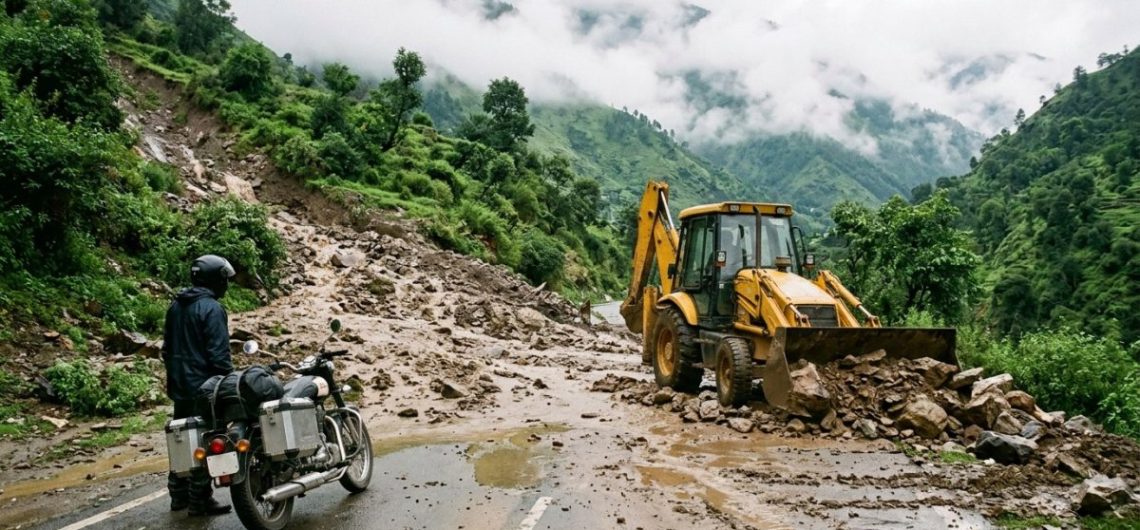
The 2026 monsoon has been another brutal one in Himachal Pradesh. By mid-August, around 157 people had died in the state since the rains began, around 260 roads were closed on a single day, and the highway through Mandi and Kullu, the main road to Manali, was blocked. Up in Lahaul, a flash flood closed the Manali-Leh highway in June. Here is what that means for anyone planning to ride to Leh, this autumn or next summer.
The season in a few numbers
The monsoon reached Himachal Pradesh at the end of June 2026 and did what it has done in several recent years: it hit the mountains hard. By 11 August, the state counted 157 deaths since the start of the season, sixty-eight of them in rain-related incidents such as landslides, drowning and a flash flood, and eighty-nine in road accidents. Around 260 roads were closed across the state at that point, with the district of Mandi worst affected, followed by Chamba, Kullu and Shimla. The highway between Mandi and Kullu, part of the main route from the plains to Manali, was blocked, and the state estimated losses of more than 880 crore rupees in damage to property and public works.
The season was far from over. By 2 September, the toll had risen to 259 deaths, 106 of them linked to the rains and 153 to road accidents, about 150 roads were still blocked, and the estimated losses had climbed to more than 1,200 crore rupees.
Behind the numbers are the images that have become depressingly familiar in the Himalaya: rivers the colour of chocolate milk tearing at their banks, hillsides sliding onto roads, cars swept off bridges, villages cut off for days. The weather office kept issuing orange alerts for heavy rain across several districts well into August. Anyone who follows the region will know that 2025 was also a severe year, and that the pattern of intense cloudbursts and flash floods seems to be getting worse rather than better.
The Manali-Leh road in June
The road that matters most to riders, the Manali-Leh highway, took its first hit before the monsoon proper had even settled in. At the end of June, a flash flood near Jispa, north of Keylong, spilled across the road and closed the highway, and the Border Roads Organisation had machines working to reopen it as soon as the water dropped. Around the same time, in another corner of Lahaul, a snowmelt surge down the Jhalma stream flooded the Jobrang bridge and cut about a dozen villages off from Keylong, the district headquarters.
That episode is a good illustration of how the high road works. The Manali-Leh highway is not just vulnerable to the monsoon rains that hammer the lower valleys around Kullu and Mandi. It is also exposed to glacier and snowmelt surges in early summer, to rockfall on the long climbs, and to snow at the top of the passes almost any week of the year. The BRO keeps it open with remarkable skill, but nobody who knows the road treats an open status as a promise.
Why Himachal suffers so much in the monsoon
Himachal Pradesh sits on the southern face of the Himalaya, where the monsoon clouds from the plains hit the mountains and drop their water. The valleys are steep, the rivers are young and fast, and the hillsides are made of fragile, broken rock and soil. Over the past few decades, the state has built roads, hydropower projects, hotels and towns at a remarkable pace, often on slopes that were never stable. When a cloudburst drops a huge amount of rain on a small catchment in a few hours, the combination is lethal.
Ladakh, on the other side of the main Himalayan range, is a high desert in the rain shadow, and receives very little monsoon rain. That is why Leh can be sunny while Manali is drowning. But the only two road routes into Ladakh, from Manali and from Kashmir, both start on the wet side of the mountains, which means the approach can be closed even when the destination is perfectly dry.
What the Atal tunnel changed, and what it did not
Six years after it opened, the Atal tunnel under the Rohtang pass has changed the geography of the Manali-Leh road. At a little over nine kilometres long, it lets traffic from Manali bypass the Rohtang, a pass notorious for mud, jams and early snow, and pop out in the Lahaul valley in a matter of minutes. Lahaul, once cut off for half the year, is now a weekend destination for day trippers from Manali, and the traffic at the south portal on a summer Sunday can be spectacular in the wrong way.
What the tunnel did not change is everything north of it. The road still climbs over the Baralacha La, crosses the high plains around Sarchu, winds up the Gata loops and crosses the Lachulung La and the Tanglang La before dropping to the Indus. Those stretches are exactly as exposed to snow, rockfall and snowmelt surges as they ever were. The tunnel made the start of the journey easier. It did not make the journey easy.
Kashmir: the other way in
The second road into Ladakh runs from Srinagar through Sonamarg, over the Zoji La to Drass and Kargil, and on to Leh. It is lower than the Manali route for most of its length, which makes acclimatisation gentler, and the Zoji La, once shut for around four months a year, now closes for only a couple of weeks thanks to years of work by the road builders. Between January and July 2026, it carried about two thirds of all the visitors who reached Ladakh by road, some 116,500 out of 173,000.
The Kashmir route has its own weather risks, with landslides and snow on the Zoji La, and its own security context, which every rider should check before travelling, especially after the attack at Pahalgam in 2025. But for many riders it is a sensible alternative when the Himachal side is being battered by the monsoon, and some itineraries use one route in and the other out to see both sides of the range.
Reading the road reports like a local
Information is the most valuable thing you can carry in the Himalaya in the monsoon. The state authorities in Himachal publish daily figures on closed roads, the district administrations in Lahaul and Kullu post updates, and the Border Roads Organisation announces openings and closures on the high road. In Ladakh, the administration and the police share information on the passes. Local hotel owners, taxi drivers and bike rental shops often know about a closure before any of those official channels do.
The trick is to use all of them, every day, and to treat forecasts with healthy suspicion. A road that is open at nine in the morning can be closed by a cloudburst at two in the afternoon. A closure that sounds dramatic in the news may be cleared in a few hours. Experienced local guides spend their evenings on the phone for exactly this reason, and they rarely commit the group to a stage until they have heard from someone who can see the road.
Spiti, the high road with the same problem
Riders who love the idea of the Himalaya often look at Spiti as an alternative to Ladakh: a high desert valley on the Himachal side, reached through the Kinnaur valley on one side and over the Kunzum La from Lahaul on the other. It is spectacular, and it sits largely in the rain shadow, but the roads that lead into it do not. The route through Kinnaur follows the Sutlej through one of the most landslide-prone gorges in the country, and the monsoon regularly closes sections for days.
The same logic applies as for the Manali road: spectacular in the right weeks, a gamble in the wrong ones. Spiti in late May, June or September, with the right preparation, is one of the great rides of India. Spiti in the middle of a heavy monsoon is a test of patience that not every holiday can afford.
What it means for autumn 2026
As the monsoon retreats in September, the lower valleys of Himachal usually dry out and the repair crews get to work. The Kullu valley, the approach to Manali and the Atal tunnel under the Rohtang, which has transformed access to Lahaul since it opened in 2020, all come back into normal use. For a rider who wants to do Manali to Leh in late September or early October, the main question shifts from rain to cold: the high passes on the route, the Baralacha La and the Tanglang La among them, get their first serious snow in autumn, and the road usually closes for the winter some time in October or November, depending on the year.
That makes autumn a short and slightly nervy window. When it works, it is magnificent: clear skies, empty roads, the first dusting of snow on the peaks and the valleys of Lahaul turning gold. When it does not, you can find yourself waiting in Keylong or Sarchu for a pass to be cleared, or turning back. Anyone planning the full road journey this late in the season should build in spare days and be ready to change the plan.
What it means for next season
For riders planning 2027, the lesson of the last two monsoons is about timing. The Manali-Leh highway usually opens in late spring, when the BRO clears the snow from the passes, and the first weeks after opening, before the monsoon reaches Himachal around the end of June, are often the most reliable time to ride the full route. The road can be rough and wet with snowmelt at that time, and the walls of snow at the top of the passes are spectacular, but the risk from monsoon landslides on the approach is at its lowest.
July and August are the riskiest months for the Himachal side of the journey, as this year and last year have shown. September can be excellent once the rains ease, but it varies from year to year. We would not tell anybody to avoid Ladakh in summer. We would tell them to think carefully about whether to ride in from Manali in the middle of the monsoon, and to have a plan for the days when the road decides otherwise.
Why our Himalayan ride flies into Leh
It is worth being transparent about how our own Himalayan ride deals with this. The Real Himalayan Ride starts with a flight to Leh, not with the road from Manali. The group takes a rest day in Leh to acclimatise, rides an easy warm-up to the monasteries of Hemis and Thiksey, and then sets off on a loop through Ladakh itself: west along the Indus, over the Khardung La into Nubra, across to Pangong and the Umling La, and down to Tso Moriri. Because the whole route is on the dry side of the Himalaya, a landslide in Mandi or a flash flood in Lahaul does not stop the tour.
That choice has a cost, because the road from Manali is one of the great rides of the world and some riders want to do it at least once. But it has a big advantage in reliability, particularly in the monsoon months when the Himachal side is at its most dangerous. For riders who do want the full Manali to Leh road, the right answer is to choose the dates carefully, accept that the plan may change, and ride with people who know how to handle a closure.
Riding the high road safely, when it is open
For those who do ride from Manali, a few rules help. Check the road status with the local authorities and the BRO before setting out each day, not just the evening before. Start early, because afternoon snowmelt raises the water level at the famous stream crossings, and a crossing that is easy at seven in the morning can be dangerous at three in the afternoon. Carry warm clothing even in July, because the temperature at the top of a 5,000-metre pass can drop close to freezing in a storm.
Respect the altitude. The road climbs from around 2,000 metres in Manali to more than 5,000 at the highest passes, with nights spent at high camps like Sarchu, and acute mountain sickness is common among riders who push too fast. Build in time to acclimatise, drink plenty of water, and turn back or go down if the symptoms get worse. The most dangerous thing on the Manali-Leh highway is not the road. It is the rider who will not accept that the plan needs to change.
Packing for four seasons in a day
The Manali-Leh road can give you all four seasons before lunch. Warm and humid in the Kullu valley, cold and wet in the clouds at the Atal tunnel, freezing wind at the top of the Baralacha La, and fierce high-altitude sun on the plains around Sarchu. Pack layers rather than one big jacket: a thermal base layer, a warm mid layer, a riding jacket with a waterproof membrane or a separate rain suit, and a spare pair of dry gloves in a sealed bag. Waterproof boots are not a luxury on a road with stream crossings.
A small pulse oximeter, the kind that clips on a finger, is a cheap and useful tool for keeping an eye on how your body is coping with altitude, although it does not replace listening to your symptoms. Sunscreen and good sunglasses matter more than people expect at 5,000 metres, where the sun burns through cloud. And carry a little cash in small notes, because the tea tents and dhabas along the high road, where you will spend some of the happiest half-hours of your life, do not take cards.
The people on the other side of the headlines
It is easy for visitors to read monsoon news in terms of roads and trips. For the people of Himachal, the rains are something else. Families in Mandi and Kullu have lost homes and relatives. Farmers in the apple-growing valleys have lost crops and orchards. Small hotel owners along the Kullu-Manali road, who depend on summer visitors, have watched their season wash away for the second year running. The road accident deaths in the monsoon statistics are a reminder that the rains make every journey more dangerous, not only for tourists.
When the roads reopen and the season turns, visitors who come back to Manali and the valleys of Himachal are helping those communities recover. Riding through with patience, spending money locally and treating a road closure as an inconvenience rather than a personal insult are the least any of us can do.
A note on insurance and cancellations
Any trip that relies on mountain roads in the monsoon zone should be backed by travel insurance that covers delays and cancellations caused by natural events, and by an itinerary with a few spare days. Buy the insurance when you book, not later, because once a flood or a landslide is in the news, it can count as a known event and fall outside new policies. And check that the policy covers riding a motorcycle of the size you will ride, at the altitudes you will reach. Some policies exclude travel above a certain height unless you add specific cover.
Operators who run the Himalaya every year build flexibility into their plans because they have to. Riders who organise their own trips should do the same. A three-day buffer at the end of a Himalayan itinerary is not wasted if the road stays open. It is a few days in Leh with good coffee and mountain views.
Riding the Himalaya for real
The 15-day Real Himalayan Ride flies you into Leh and keeps the whole route on the dry side of the mountains, with time to acclimatise, an English-speaking guide, an experienced mechanic and a service vehicle for luggage and pillions. It is a guided tour designed around the reality of the Himalayan seasons, and our Himalayan motorbike tours page has more options for riders who want to see more of the range.
Planning the Himalaya for next year? Ask us on WhatsApp or at info@bigbiketours.com. We will tell you honestly which weeks make sense for a motorcycle tour in Ladakh, whether the road from Manali fits your dates, and how a big biking tour in the mountains can keep going when the monsoon does not cooperate. The best motorbike tour in the Himalaya is the one that is still running when the rain arrives.
 English
 Deutsch
 Español
 Français
 Italiano
Comments