

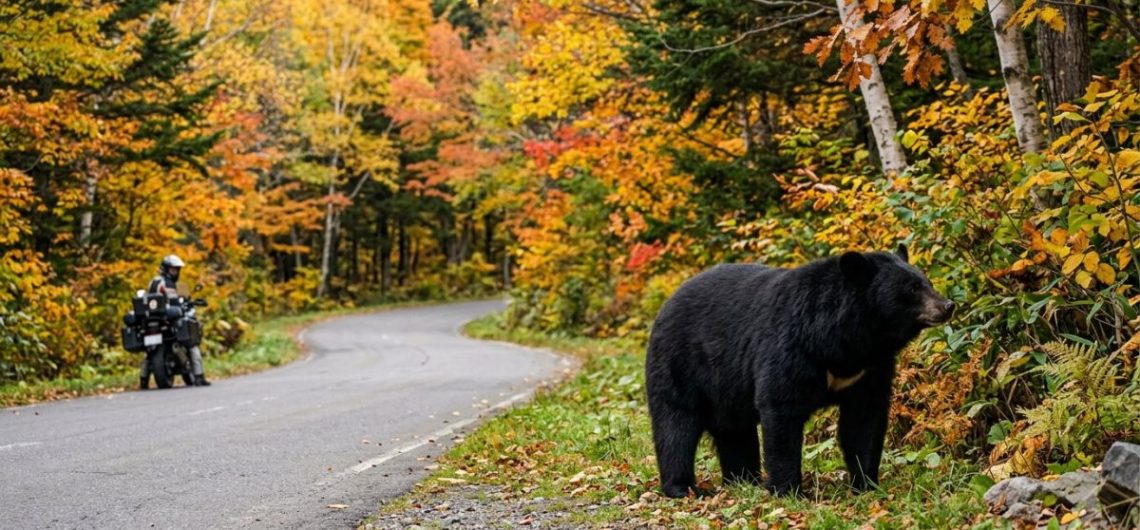
Japan had its worst year for bear attacks on record in 2025, and 2026 has not been much calmer. Tourist spots in the north are installing fences, sound devices and bear spray stations, and a famous mountain area closed its trails for a month. Here is what is actually happening, where the risk is and is not, and what a rider touring Japan this autumn should do about it, without panicking and without being naive.
A record nobody wanted
In the fiscal year that ran from April 2025 to March 2026, Japan recorded 216 bear attacks that left 238 people injured or dead, thirteen of them killed, more than double the previous record for fatalities. The year before had seen eighty-five casualties and three deaths. Bears wandered into towns, supermarkets, schools and hot spring resorts in the north of the country, and sightings reached a total of more than fifty thousand, the highest since records began in 2009.
2026 started badly too. The first fatal attack of the year happened in Iwate prefecture on 21 April, with further suspected deaths in Iwate and Yamagata soon after. Between April and June, more than twelve thousand sightings were reported. In June, a person was killed in the Hakkoda mountains of Aomori, a popular hiking and hot spring area, and the trails there were closed for about a month, reopening on 1 August. In May, two people were injured on the walkway to Shomyo Falls in Toyama, one of the most visited waterfalls in the Japanese Alps.
Why the bears are coming down
The explanations offered by Japanese researchers are a mix of nature and society. In some recent years the crops of beech nuts and acorns that bears depend on in autumn have failed, pushing hungry animals to look for food elsewhere. At the same time, the bear population has grown over the past two decades, while rural Japan has emptied. Abandoned farmland, untended orchards and shrinking villages have created a landscape where forest and settlement blur together, and bears have moved in.
The result is a pattern that alarms people in the north: a large share of recent attacks happened in or near towns and residential areas rather than deep in the mountains. Koji Yamazaki, one of Japan’s best-known bear researchers, summed up the situation after this spring’s deaths by pointing to the growing population, the abandoned farmland and the depopulation of the Tohoku region. This is not a freak year. It is a trend.
Where the bears are, and where they are not
Japan has two kinds of bear. The Asiatic black bear, medium-sized with a pale crescent on its chest, lives in the forests of Honshu, the main island, from the northern tip down through the Japanese Alps and the Chugoku mountains in the west. Estimates put their numbers in the tens of thousands. The much larger brown bear lives only in Hokkaido, the northern island, where there are thought to be around twelve thousand.
Two parts of Japan are essentially free of bears. Kyushu, the southern island of volcanoes and hot springs, lost its last black bears decades ago and they are considered extinct there. Shikoku has only a tiny remnant population in its remote mountains. For riders, that geography matters a lot. The worst-affected areas in 2025 and 2026 are the Tohoku region of northern Honshu, particularly Akita, Iwate, Aomori and Yamagata, and parts of Hokkaido. The Alps have bears too, as the Toyama incident showed, but the numbers of incidents there are much lower.
What tourist areas are doing about it
The places that depend on visitors have not waited for the government. At Shomyo Falls in Tateyama, high-frequency sound devices designed to keep bears away have been installed along the approach. In Aomori’s Hakkoda range, tour operators now require participants to carry bear spray or bells. Hot spring resorts in Akita have built fences around their grounds. They have also tightened rules on food waste, since rubbish is one of the things that draws bears to human places in the first place. One hot spring resort in Odate spent at least a million yen fencing its grounds.
Akita prefecture has gone further, offering discounts of up to 12,000 yen per person on overnight stays to bring visitors back, and a major Japanese insurer now offers cancellation cover for businesses hit by bear incidents. The message from the tourism industry is clear: we know there is a problem, we are dealing with it, please keep coming.
Is a rider on a motorcycle at risk?
Let us put the risk in proportion. Most victims of bear attacks in Japan are local people doing things in the forest: gathering wild mountain vegetables in spring, harvesting mushrooms and chestnuts in autumn, working in fields at the edge of the trees, or walking in the early morning and at dusk. A rider moving along a road on a motorcycle, with an engine running and a helmet on, is not in the same situation.
The moments when a rider becomes a pedestrian in bear country are the ones to think about. Stopping at a remote viewpoint and walking into the trees for a photograph. Pulling over on a forest road for a toilet break. Taking a short hike to a waterfall at the end of the day. Camping. Eating a picnic at a quiet spot and leaving scraps. Those are exactly the activities that put hikers and foragers in trouble, and they are the ones to approach with some care in the north.
Practical habits in bear country
The advice from Japanese authorities is simple and sensible. Avoid walking alone in forests at dawn and dusk, when bears are most active. Make noise on forest paths; the bells you see hanging from hikers’ backpacks in Japan are not decorative. Never leave food or rubbish behind, and do not feed wildlife of any kind. If you see a bear at a distance, do not approach it for a photograph, do not run, and back away slowly while keeping it in sight. Check local warnings before you head into a hiking area, especially in Tohoku and Hokkaido, where sighting maps and closures are updated regularly.
On the bike, the main extra habit is to be alert on forest roads at dawn and dusk, just as you would be for deer, monkeys or wild boar, all of which you will meet in rural Japan. A bear crossing the road in front of you is rare, but not unheard of in the north. Ride at a speed that lets you stop, especially on roads lined with trees and on the approach to blind corners in the mountains.
What about bear spray?
Bear spray is sold in Japan, and some tourist sites now make it available to hikers. It is a sensible thing to carry if you plan to spend time on foot in the northern forests. Two points, though. You cannot fly with it, so buy it locally and leave it behind when you go. And a canister in the bottom of a pannier is useless in an emergency. If you are going to carry it on a walk, carry it on your belt, and know how to use it before you need to.
For most riders on a road-based trip, bear spray is not essential. Good habits, noise, awareness and not walking alone into the forest at dusk are what reduce the risk. The spray is a last line of defence for people who spend real time on foot in bear country.
If you do meet a bear
Japanese wildlife authorities give the same basic advice to everyone. If you see a bear at a distance and it has not noticed you, back away quietly the way you came. If it has noticed you, stay calm, do not run and do not turn your back; running can trigger a chase, and no human outruns a bear. Back away slowly while facing it, and give it space and a clear way out. Never get between a mother and her cubs, and never approach a bear for a picture, however relaxed it looks.
If the worst happens and a black bear attacks, the advice is to protect your head and neck, which is where most serious injuries happen. Lie face down with your hands clasped behind your neck, or curl up to shield your face and throat. For riders, that is one more reason why a helmet and a jacket on a short walk from the bike in bear country are not as silly as they look. It is an unlikely scenario. It is also one where the details matter.
Hokkaido: brown bear country
Hokkaido deserves its own paragraph, because its brown bears are a different animal from the black bears of Honshu: much bigger, and in some places very used to people. The Shiretoko peninsula in the far north-east, a World Heritage site, has one of the densest brown bear populations in the world, and bears are often seen from boats along the coast and from the roads. At the famous Shiretoko Five Lakes, visitors in the active season walk an elevated boardwalk, and access to the ground-level trails is controlled, with guided walks or a short bear lecture required at certain times of year.
Riders who visit Hokkaido in summer and autumn will see bear warnings at almost every trailhead and many roadside rest areas. Take them seriously, never stop to feed or photograph bears from beside the road, and do not leave food on your bike when you walk away from it. The bears of Shiretoko have learned what a picnic smells like.
The rest of Japan’s roadside wildlife
Bears make the headlines, but they are not the animals you are most likely to meet on a Japanese mountain road. Deer are the real hazard for riders in many rural areas, particularly in Hokkaido, where the big Ezo deer cause a large number of road accidents every year, especially at dawn and dusk. Wild boar root along the verges in many parts of the country, and Japanese macaques, the snow monkeys, sit on guard rails in the mountains of Nagano and elsewhere, watching riders with an expression of mild disdain.
In Hokkaido you will also see foxes, often very close to the road and apparently tame. Do not touch or feed them. Apart from the obvious reasons, foxes in Hokkaido can carry a parasite that is dangerous to humans, and local authorities warn visitors about it. The general rule for all Japanese wildlife is the same as for bears: enjoy it from a distance, keep your food to yourself, and ride at a speed that lets you stop when something with four legs steps out of the trees.
Autumn: the season to take it seriously
Timing matters. Bears are most active and most hungry in autumn, when they eat as much as they can before hibernating in the winter. That is also the peak season for visitors in the north of Japan, when the leaves turn red and gold in the mountains of Tohoku and Hokkaido from late September onwards. Mushroom and chestnut gathering, which bring local people deep into the forest, peak at the same time.
In years when the nut crop fails, the autumn is when bears come down into villages and towns in search of persimmons, rubbish and anything else they can find. If you are touring the north in October, expect to see warning signs, closures of some trails and local advice to stay out of certain areas. Take them seriously. They are not there to spoil anyone’s holiday.
Evenings in the mountain onsen towns
One of the great pleasures of a riding day in Japan is the end of it: a mountain onsen town, a hot bath, a long dinner and a walk through the lanes in a cotton robe and wooden sandals. In most of Japan that walk is as safe as anything you will ever do. In the parts of the north where bears have been coming into settlements, it deserves a small adjustment. Stay on the lit streets of the town, do not wander along the dark riverside paths into the trees, and pay attention if the inn staff mention a recent sighting. They are not trying to frighten you; they know their neighbourhood.
The same applies to the outdoor baths some inns have at the edge of the forest. Many of the affected resorts have fenced their grounds, and staff will tell you if an outdoor bath is closed for safety reasons. It is a small price to pay for soaking in hot water under the stars with the smell of cedar in the air, which is still one of the finest ways to end a day on a motorcycle anywhere.
Rethinking the northern route
Does this mean riders should avoid Tohoku and Hokkaido? No. Both are among the best riding regions in Japan, with long empty roads, volcanoes, lakes, hot springs and some of the finest autumn colours anywhere. The overwhelming majority of visitors, including riders, go home with nothing more dangerous to report than an overenthusiastic onsen and a lot of seafood. The risk is real, but it is concentrated in specific activities and specific moments.
What it does mean is that a trip to the north in autumn deserves a bit more planning than it used to. Choose accommodation in towns and established onsen resorts rather than isolated campsites. Plan short walks for the middle of the day. Keep up with local news in the areas you are riding through, and adjust if a trail or road has been closed. On a guided ride, that kind of planning is part of the job of whoever leads the group.
Where our Japan ride goes
It is worth being transparent about our own route. Our 20-day Japan ride starts in Osaka and runs through western Japan, the island of Kyushu, Hiroshima and the mountains of central Honshu, including the Japanese Alps. Kyushu, one of the highlights of the trip, has no wild bears at all. The Alps do, and in those sections the usual precautions apply: stay on established paths on short walks, keep food packed away, and follow local advice at waterfalls and trailheads.
We do not currently run the Tohoku region or Hokkaido as part of a scheduled departure, so the areas worst affected by the 2025 and 2026 incidents are not on our standard route. Riders who dream of the north should talk to us first, and any plan for Tohoku or Hokkaido in autumn should be built with the bear situation firmly in mind, choosing seasons, stops and walks accordingly.
The bigger story behind the bears
It is hard to write about Japan’s bear crisis without seeing the bigger picture. Rural Japan is ageing and shrinking faster than almost anywhere in the world. Villages that once had hunters, farmers and busy fields now have a handful of elderly residents and a lot of empty houses. Wildlife fills the space left behind. The bears are, in a sense, a symptom of depopulation as much as of bad acorn years.
For visitors, that has a positive side too. The same empty countryside that bears are reclaiming is the countryside that makes Japan such a wonderful place to ride: quiet roads, tiny villages, mountain passes where you might not see another vehicle for twenty minutes. Travellers who spend money in those places, in family-run inns and small restaurants and roadside stations, are part of what keeps them alive.
Riding Japan for real
The 20-day Japan ride takes you from Osaka through Kyushu, Hiroshima and the Japanese Alps with a road captain, support and hotels booked, and with local knowledge about everything from tolls to wildlife. It is a guided tour for riders who want the mountains and the coast of Japan without the guesswork, and a motorcycle tour that goes where the crowds do not. For other options, see our Japan page.
Thinking about riding the north, bears and all? Ask us on WhatsApp or at info@bigbiketours.com. We will tell you honestly what a big biking tour in Japan looks like for your dates, and how to plan a motorbike tour in the north that keeps the wildlife where it belongs.
 English
 Deutsch
 Español
 Français
 Italiano
Comments