

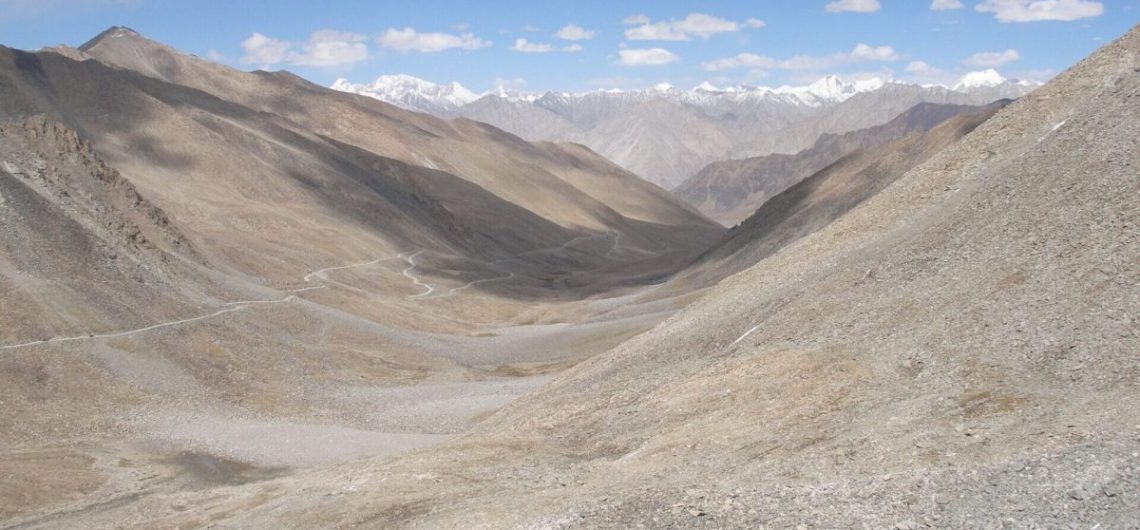
Four passes, four personalities, same region
If you landed here, you’ve seen a hundred photos of yellow BRO signs with altitude numbers and jokes about “Paradise Unlimited” stencilled on them, and you’re trying to figure out which ones are the real bosses and which ones are just Instagram stops. Ladakh has roughly a dozen high passes with a ribbon of tarmac over them. Four of them will shape your trip. Khardung La, Chang La, Wari La and Tanglang La. Each one has its own weather, its own grade, its own surface mix, and its own failure modes. Ride them blind, you get hurt. Ride them knowing who they are, you come home with stories.
This is not a checklist. This is what the four passes feel like from the saddle, and what every Ladakh rider who’s done them more than twice will tell you over a beer in Leh. Consider this a motorcycle tour briefing from people who’ve already eaten the dust.
Khardung La, the first handshake
Khardung La is the one everyone photographs. Official altitude 5 359 metres, and yes, the “highest motorable pass in the world” claim has been contested for years by Umling La and a few others, but Khardung La is still the one every rider crosses to get from Leh to Nubra Valley. The climb starts in Leh at 3 500 m and gains 1 850 m over 39 kilometres. Not the longest climb in the Himalaya. Not the steepest. But the altitude gain per hour is brutal because the road is decent and you can go faster than your body wants to.
The south side climb to South Pullu is now fully tarmacked and has been since 2022. You can genuinely ride it at 50 km/h the whole way. This is the trap. You feel fine at 4 200 m, you feel fine at 4 800 m, you feel something wrong at 5 100 m, and by the time you’re standing at the sign at 5 359 m fumbling for your phone to take a photo, your fingers won’t work and you can’t remember your wife’s name. The military checkpoint at South Pullu exists precisely to slow riders down and force a ten-minute break. Use it. Drink half a litre of water. Eat a Snickers. Then continue.
Khardung La, the other side
The north descent to North Pullu and then into Khalsar is where Khardung La changes character. The tarmac gives way to broken surface, then gravel, then the occasional stream crossing where meltwater from overhead glaciers sheets across the road. By the time you reach North Pullu, 14 km in, you’re on legitimate adventure terrain. Nothing catastrophic. Lots of first-timers drop the Himalayan here because they’re still processing the altitude and trying to modulate the clutch on a 15 percent downhill with scree in the corners.
BRO crews keep this side in reasonable shape all summer. The problem is the snow chase. Late May the road is open but the top 2 km each side still have meltwater. Early September the road is pristine. Mid-October the first storms coat the top again and it closes briefly. Safest riding window, mid-June to mid-September. Window for peace and empty sign photos : early June or late September, if you’re willing to risk a day lost to weather. If you’re crossing Khardung La as part of a guided tour, the operator will time it to mid-morning, once the sun has burned off the morning ice and before the afternoon wind picks up. Not an accident.
Chang La, the quiet tyrant
Chang La sits at 5 360 metres (the BRO sign insists it’s 5 360, the GPS says 5 391, take your pick), and it’s the pass that gets you from Leh over to Pangong Tso. The south side climb from Karu is longer than Khardung, 50 km, and the gradient is gentler, which fools riders into thinking it’s easier. It isn’t. The altitude at the top is the same but you’ve had less time to complain about it, so the oxygen debt arrives all at once when you park at the top sign.
The surface on Chang La is the big discussion. Until 2019 it was legendary bad : broken pavement, meltwater channels, a cratered top section that destroyed suspension. BRO did a major rebuild 2020-2022 and now the south ramp is 90 percent new tarmac. The north descent to Tangtse still has rough patches, especially the 8 km drop into the Durbuk valley. Chang La is the pass where engine performance first becomes obviously bad. A Royal Enfield Himalayan 452 loses roughly 40 percent of its sea-level power at 5 300 metres. You’ll notice it on the last hairpin up. You’ll notice it more on the loaded climb back out of Tangtse if you’re doing a day return.
Chang La, the weather card
Chang La is the first pass to close in October and one of the last to fully clear in May. Its position perpendicular to the main monsoon flow means it catches storm systems that Khardung La misses. If Pangong is your destination and Chang La is shut, your only alternative is the Shyok route via Nubra and Durbuk which adds 180 km and a military checkpoint that doesn’t always let you through. So Chang La is the gatekeeper for Pangong, and in a bad weather window you lose the lake entirely.
For the military-history fans, Chang La is also the pass that separates Indian-administered Ladakh proper from the Changthang plateau, and the checkpoint at Tangtse is where your Inner Line Permit gets inspected. No permit, no Pangong, no exceptions. Our regional permits deep dive covers the logic, though the specific Ladakh paperwork differs in detail.
Wari La, the quiet one
Wari La is the pass nobody talks about. 5 312 metres, connecting Sakti (south of Karu on the Leh-Pangong road) over to Tangyar and down into the Nubra Valley near Agham. It’s the fourth highest motorable pass in Ladakh and arguably the most beautiful, and on most days of the summer season you can ride it with no other vehicle in sight. Not a single one. This is not a figure of speech.
The reason Wari La is empty is simple : the road surface is garbage. The south side climb from Sakti has 35 km of broken tarmac, gravel sections, and at least two landslide zones that get re-patched every summer. The top 5 km on the approach is washboard. The descent to Agham has a 12 km stretch of loose scree where the BRO hasn’t won the battle. A confident rider on a properly shod Himalayan (knobbies or at least 50/50 tyres) will love Wari La. A road tourer on street tyres will have a miserable day and a bike that rolls with the camber in uncomfortable ways.
Wari La, the reason to go anyway
Why ride Wari La if the road is rough ? Because it’s the alternative loop that lets you do Leh-Pangong-Nubra as a single loop instead of an out-and-back. You ride Chang La to Pangong, you spend a day at the lake, you push north via Shyok (military-dependent) or back to Sakti and up Wari La to cross into Nubra, and you come home via Khardung La. That’s a five-day ride that crosses three of the four passes in a logical circuit and gives you the Changthang plateau, Pangong, Nubra and the classic Khardung climb in one trip.
The BRO maintenance cadence on Wari La is once a year in late May or early June, then patches after the monsoon whisker in August. By late September the road is good. By mid-October it’s shut. Most riders doing a full big biking tour of Ladakh skip Wari La on the first visit and come back for it on the second. If you’re confident on gravel and you’ve got the schedule, the loop is worth it. If you’re not, the out-and-back via Chang La to Pangong and the return by the same road is absolutely fine and you lose nothing.
Tanglang La, the last boss
Tanglang La at 5 328 metres is the pass that closes out the Manali-Leh highway, 108 km south of Leh, and it’s the one every northbound rider photographs because it’s the first time they’ve crossed 5 000 m on a real climb. BRO sign, the famous “You are passing through the second highest pass in the world” (obsolete wording, nobody updates it), the thin air slapping you in the face the moment you stop. After 14 days of Ladakh riding, you know what to do. On day five coming up from Pang, freshly climbed from 4 500 m to 5 328 m in 40 km, you might be reeling.
The climb from Pang is the one that eats the engine. Your Himalayan loses half its power from Pang onwards, and the final 4 km of switchbacks up to the top of Tanglang have an 8 percent average gradient that feels like 15. Guys who downshift to second on a loaded Himalayan and grind at 3 000 rpm arrive at the top with an engine that’s cooked. The trick is to not fight it : third gear, low revs, let the bike breathe, take twenty minutes longer if you need to. Every rider’s instinct to accelerate on a grade up here is the wrong instinct. The mountain wins every time if you push.
Tanglang La, the descent nobody photographs
The north descent from Tanglang La down to the Morey Plains is a 28 km ramp that loses 1 400 m of altitude over some of the smoothest tarmac in Ladakh. This is where a lot of crashes happen. Fresh snow melts into a thin slick on the corners in early morning. Afternoon sun dries it out, but then the wind at Morey picks up to 40 km/h and you’ve got a crosswind component that pushes a loaded adventure bike two feet sideways per gust. Standing on the pegs helps. Relaxing your grip helps more. The common mistake is death-gripping the bars and letting the bike fight you.
Once on the Morey Plains you’re at 4 700 m for 40 km of nearly flat straight tarmac. Feels like freedom. Is also the stretch where your eyelids start to droop because you’ve just crossed the highest pass of your life and the adrenaline is leaving. Riders regularly fall asleep on Morey. Two riders a year end up in the ditch. The fix is cheap : stop at the halfway tent for chai, stretch, eat something, then continue. Five minutes. Saves your afternoon.
The BRO, the guys who keep the roads alive
The Border Roads Organisation is a uniformed engineering corps of the Indian Army that maintains every pass we’ve just described. Their maintenance cadence matters for every rider planning a Ladakh trip. BRO does a spring opening blitz on Manali-Leh and the Leh-Nubra corridor from late April to mid-May, with bulldozers clearing the top section of each pass. Then there’s a summer maintenance cycle where patches get repaired every three to four weeks. By late August the surface is at its best. Then from mid-September the first snow dustings start arriving and BRO shifts into closing mode.
Practical implication for riders : passes open in a predictable order. Khardung La first (late April usually), then Chang La (early May), then Manali-Leh with Tanglang La (mid-May typically), then Wari La (early June). They close in reverse order in October. For a rider planning a tight window, the usable season for all four passes open is approximately 15 June to 25 September. Outside that window, at least one pass is typically shut. Our month-by-month guide for Tibet and the Himalayan region lays out the nuances by period.
Altitude numbers, what they mean on a motorcycle
At 5 000 m you’ve got 53 percent of the oxygen available at sea level. At 5 300 m (all four passes are within 30 m of this altitude) you’re at 50 percent. Your engine loses roughly the same proportion of power because combustion is oxygen-dependent. A stock Himalayan 452 makes around 40 hp at sea level and about 20 hp at 5 300 m. You will notice this. What surprises most riders is the time it takes your body to recover after each pass crossing. A fit 40-year-old drops back to 90 percent SpO2 within about an hour of descending to 4 000 m. A 55-year-old takes four hours.
This is why the sensible Ladakh itinerary crosses one pass per day, not two. Pushing Khardung La and Wari La in the same day is technically doable in 14 hours, but you pay for it the next day with a headache that won’t quit and an acclimatisation reset. Our altitude sickness guide covers the physiology in full. It’s the Tibet framework but it reads identically for Ladakh.
Surface per km, the rider’s cheat sheet
Khardung La, Leh to Khalsar, 78 km : 40 km tarmac, 25 km broken/patchy, 13 km gravel. Chang La, Karu to Tangtse, 85 km : 55 km tarmac, 20 km broken, 10 km gravel in the descent. Wari La, Sakti to Agham, 82 km : 15 km tarmac, 40 km broken, 27 km loose scree. Tanglang La, Pang to Rumtse, 95 km : 80 km smooth tarmac, 10 km patchy, 5 km gravel near the pass. That’s the usable mental model. Plan your fuel and your pace accordingly. A loaded Himalayan averages 35 km/h on broken surface and 55 km/h on good tarmac, so a 100-km pass day ranges from 2h30 to 4h ride time excluding stops.
The fourth pass people forget
You’ll notice some Ladakh riders argue the “four passes” should include Namik La or Fotu La instead of Wari La, because those two are on the Leh-Kargil-Srinagar highway and are part of the classic northern entry to Ladakh. Fair point. For a rider entering Ladakh from the Kashmir side rather than the Manali side, Fotu La (4 108 m) and Namik La (3 700 m) are the gatekeepers. They’re lower, warmer, and have better surface than any of the four we’ve covered. They’re also less dramatic. If you’re doing a motobike tour that includes both entries, you’ll cross all six passes in a single loop. That’s the maximum dose of Ladakh and it’s worth every rupee.
For riders who only get one entry direction, the Manali-Leh axis is the more visually rewarding, and the four passes we’ve detailed are the ones that define the experience. Fotu and Namik are the calm supporting cast. The four bosses are Khardung, Chang, Wari, Tanglang. Respect that order and the Himalaya will be kind to you.
What each pass demands of you
Khardung La demands pacing. Chang La demands weather luck. Wari La demands off-road skill. Tanglang La demands patience. Run them in the right mental state and you’ll come home with four very different stories. Try to ride them the same way and at least one will punish you. That’s the core of what an experienced Ladakh road captain does on a guided departure : not just navigate, but match the pace and the day to the pass you’re crossing. It’s also why riders who’ve done Ladakh solo once come back with a group or a guided package the second time. Not because they can’t handle it, but because the margin is better.
Riding the Ladakh passes for real
Big Bike Tours runs Ladakh departures that cross all four of these passes in a sensible order, with road captains who’ve crossed them dozens of times each, a support vehicle and mechanic on every stage, a fleet of Royal Enfield Himalayans maintained between every trip, all Inner Line Permits handled before you arrive, and a tariff that covers the lot from Leh airport pickup to Leh airport drop-off. Have a look at the Himalayan motorbike tours page for the seasonal lineup, the 15-day Himalayan Ride for the flagship that crosses Khardung, Chang and Tanglang, or the fleet page to see exactly which machine you’ll be riding. Your only job is to show up, acclimatise and ride.
 English
 Deutsch
 Español
 Français
 Italiano
Comments