

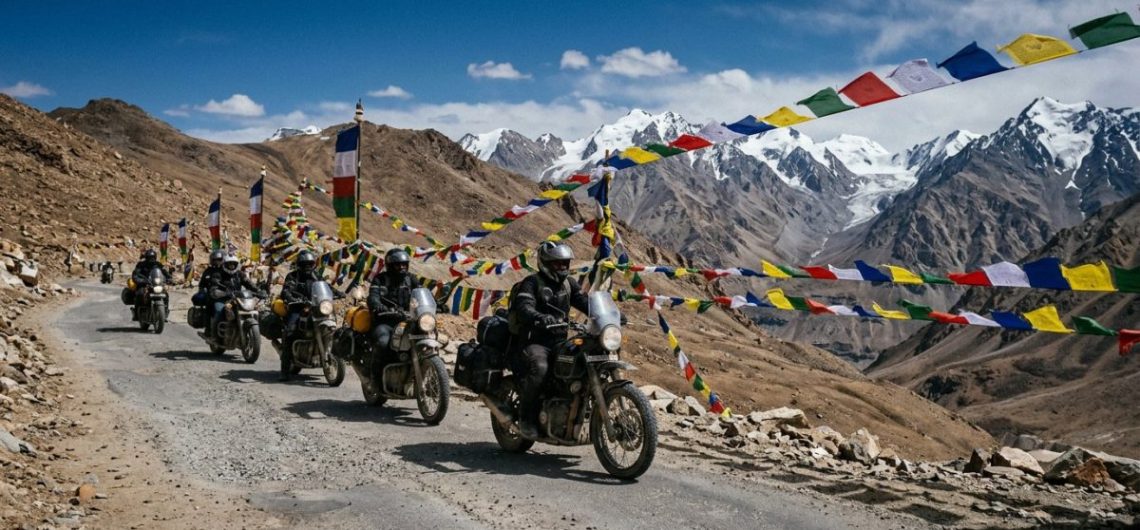
Ladakh has had the kind of year its hotel owners dream about. More than 405,000 visitors in the first eight months of 2026, already well past the total for the whole of 2025, a first-ever Ladakh Bike Week in September, and a plan on the table to make permits simpler for foreigners. Here is what is behind the boom, what it means on the passes, and how to ride the roof of India without spending your holiday in a traffic jam at 5,000 metres.
A record, after a year from hell
Between January and August 2026, Ladakh received 405,085 tourists, according to the territory’s tourism department. That is about fifty percent more than in the same months of 2025, and more than the 335,872 who came in the whole of last year. August alone brought 74,753 visitors, a jump of sixty-five percent. Foreign visitors grew too, to 33,346 in the first eight months, up by about a third, with more than ten thousand of them in August.
Part of that jump is a rebound, because 2025 was a terrible year. The terrorist attack at Pahalgam in Kashmir in April 2025 frightened travellers across the region. In May, the brief armed conflict between India and Pakistan closed Leh airport for several days and wiped out bookings, with one hotel association saying eighty percent of its reservations were cancelled. In August, record rain closed roads and grounded flights for days. And on 24 September, protests in Leh demanding statehood and constitutional protections turned violent, leaving four people dead and more than fifty injured, followed by a week-long curfew. For Ladakh’s tourism industry, 2025 was a year to forget.
The roads that changed everything
The rebound is only part of the story. The deeper change is infrastructure. The Ladakh administration says the road network has more than doubled since the territory was created in 2019, to over four thousand kilometres, with the number of bridges going from nineteen to seventy-two. The Zoji La, the pass that links Ladakh with Kashmir and used to close for around four months a year, now shuts for a couple of weeks. The road into Zanskar, once cut off for most of the winter, was closed for only about eleven days last winter. The number of registered homestays has gone from a little over a hundred to more than two thousand.
That is transformative for the people of Ladakh, and it has changed how visitors arrive. More than half now come by road. Around a third drive or ride in from the Kashmir side via the Zoji La, and roughly one in six come up from Manali over the long high road through Himachal. The Lieutenant Governor, Vinai Kumar Saxena, credited the central government’s push for infrastructure and the promotion of domestic tourism, and talked about building a year-round tourism economy with festivals in the off-season to create work for young people, artisans and homestay owners.
Ladakh Bike Week: the government discovers motorcycles
For riders, the most interesting novelty of 2026 was the first Ladakh Bike Week, held from 1 to 7 September and organised by the territory’s tourism department. It opened with a rally of eleven professional riders through eastern Ladakh towards the Galwan area, one of the most strategically sensitive regions of the Indian Himalaya, from 1 to 3 September. That was followed by a Himalayan base camp at Chuchot, south of Leh, from 4 to 6 September, with activities, workshops and exhibitions and a target of around 5,500 visitors a day, and a display of fifteen vintage and classic motorcycles in Leh market all week.
The Lieutenant Governor flagged off the event with a message about adventure tourism that is safe, responsible and environmentally sustainable, and about creating opportunities for local businesses. For anyone who has watched motorcycle travel in Ladakh grow over the years, it is a striking moment: the administration now openly markets the region as a motorcycling destination, rather than treating the thousands of bikes on its passes as something that simply happens every summer.
Permits: simpler, eventually
The other news for foreign riders came at the end of August. At a review meeting chaired by Ladakh’s chief secretary, the administration discussed simplifying the permit system for foreign visitors. Today, foreigners need a Protected Area Permit to visit many of the places that make Ladakh special, including the Nubra valley, Pangong Tso, Tso Moriri and the areas near the Chinese border, and those permits are checked at several points along the way.
The proposals include a single permit covering the whole territory except the areas that remain restricted, registration desks for foreign nationals at the airport, fewer checkpoints, facial recognition and self-registration at selected posts, and better record-keeping by hotels, taxi operators and bike rental unions. Particular attention went to the checks along the Changthang route through Upshi and Kharu and at North Pullu on the way to Nubra. The tourism department was asked to prepare a revised procedure. The important caveat: none of this has been implemented yet. For now, foreign visitors still have to follow the existing permit and registration rules.
What the boom looks like from the saddle
Numbers aside, what does a record season feel like on the ground? On the main routes, busier. The road over the Khardung La into Nubra, the climb to Chang La on the way to Pangong, and the lakeshore at Pangong itself see long lines of vehicles in peak weeks, many of them rented Royal Enfields ridden by groups of young Indian riders on the trip of their lives, and many of them SUVs full of families. Traffic jams at 5,000 metres are a real thing, and so is the smell of hot clutches on a steep switchback when a convoy of taxis meets a column of military trucks.
That is not a complaint. The domestic riding culture in India is one of the great motorcycling scenes in the world, and sharing a chai stall at the top of a pass with a dozen riders from Pune and Bangalore, halfway through their first big motorbike tour, is part of the fun. But it does mean that the classic Ladakh experience of an empty road through a lunar landscape now depends heavily on where and when you ride.
Pangong Tso is the best example. The long blue lake on the Chinese border became a national icon in India after the final scene of a hugely popular Bollywood film was shot on its shore in 2009, and it has never recovered its solitude. On a summer afternoon the shore near the main camps is lined with vehicles, props from the film and people posing on yellow scooters. Arrive in the late afternoon and stay the night, though, and the day visitors drive back towards Leh. By sunset the lake turns from turquoise to deep blue to silver, the wind drops, and the silence at 4,200 metres is enormous. That is the Pangong worth riding to.
Where the space still is
Ladakh is huge, and the crowds are concentrated on a few famous stretches. Ride west of Leh into the lower Indus valley towards the villages of the Aryan valley, or over the Namika La and Fotu La towards Kargil, and the traffic thins quickly. The road into the gorges of the Zanskar river is spectacular and far quieter than the main tourist circuit. The Wari La, an alternative high pass between Nubra and the Indus valley, sees a fraction of the traffic of the Khardung La.
In the south-east, the high Changthang plateau around Tso Moriri and the roads towards Hanle and the Umling La, the highest motorable pass in the world, remain wild and sparsely visited, partly because the permits and the altitude keep numbers down. That is where you still find the Ladakh of the old photographs: nomad camps, wild asses, huge skies and not another engine for an hour.
Timing is the other secret
The busiest weeks in Ladakh follow Indian school and public holidays, with the big peak in June and July, when the plains are unbearably hot and every family wants mountain air. July and August bring the monsoon to the rest of India, and while Ladakh itself sits in a rain shadow and stays mostly dry, the approach roads through Himachal and Kashmir can be hit by landslides and cloudbursts. September is a beautiful month on the plateau, with clear skies, colder nights and the first snow on the high passes, and the summer holiday crowds from the plains have mostly gone home.
Starting early in the day helps as much as choosing the month. The big passes are quietest in the first hours after dawn, before the taxis leave Leh and the groups on rented bikes finish breakfast. The light is better too, and the cold, thin air at that hour is the kind of experience that stays in your lungs for weeks afterwards.
Altitude does not care about statistics
More visitors also means more people arriving at 3,500 metres without understanding what altitude does to a body. Leh sits at about that height, and the highest passes climb above 5,000 metres. The single most important thing any visitor can do is acclimatise: fly into Leh and spend the first two days doing very little, drinking water and walking slowly, before riding to the high passes. Riders who come up by road from Manali acclimatise gradually on the way, which is one of the arguments for that route, provided the road is open.
Every season, hospitals in Leh treat visitors with acute mountain sickness, and a few cases are serious. More tourists means more of those cases. It is worth taking seriously even if you are fit, because fitness has very little to do with how your body copes with thin air. Headache, nausea, breathlessness at rest and confusion are signals to stop climbing, and to go down if they get worse. Go easy on alcohol for the first few days too; the beer at 3,500 metres hits harder than the one at home.
How the permit system works today
Until the reform arrives, the system for foreigners works much as it has for years. Protected Area Permits for the restricted zones are arranged through registered travel agencies in Leh or through the official online system, and they name the areas and the dates you are allowed to visit. You carry several photocopies, because checkpoints on the way to Nubra, Pangong, Tso Moriri and the south-east collect one each, and the officers at those posts check names, passport numbers and dates with the patience of people who do this all day.
For a rider, the practical consequences are simple. Your route has to match your permit, your permit has to match your passport, and your paper copies have to survive rain, dust and the bottom of a tank bag. On an organised ride, the organiser can tell you exactly what is needed and help with the paperwork. On an independent trip, a good local agent in Leh saves hours and a lot of frustration. If the single permit does come in, much of this will become easier, and independent travel for foreigners will be simpler than it has ever been in Ladakh.
A frontier, not just a playground
Ladakh is also one of the most militarised regions on earth. It borders China and Pakistan, and the army is everywhere: convoys of trucks on the passes, camps in the valleys, checkpoints on the roads to the border areas. The first Bike Week’s rally towards Galwan was a pointed choice of route, in an area that became world news after the clash between Indian and Chinese troops in 2020. For visitors, the military presence is mostly a background, and often a friendly one: soldiers at remote posts are usually happy to see a group of riders.
But a few rules matter. Do not photograph military installations, convoys or bridges where signs forbid it. Do not stray off the permitted roads towards the border areas, however tempting a track looks on the map. And give way to army convoys on narrow mountain roads; they have the right of way in practice, and their drivers have jobs to do. Riders who follow those simple rules find that the army is also the organisation that keeps the passes open, clears the snow and builds the roads, and that is worth a wave of thanks.
The people you will meet
Ladakh’s human geography is as varied as its landscape. Leh and most of the east are Buddhist, with monasteries on every hilltop, prayer flags on every pass and chortens at every village entrance. Kargil and the west are largely Muslim, with a Balti and Shia culture that feels closer to the valleys of Baltistan across the line of control. The Changthang plateau is home to nomadic herders who move with their yaks, goats and sheep through the seasons. Villages in the lower Indus valley are known for their apricot orchards and distinctive traditions.
The homestay boom means more visitors now sleep in family houses, which is one of the best things that has happened to travel in Ladakh. You eat what the family eats, thukpa noodle soup, skyu pasta stew, bread from the clay oven, butter tea that tastes like soup to anyone who expects tea, and you get a glimpse of a way of life that is changing fast. Take your shoes off, walk clockwise around chortens and prayer walls, ask before photographing people and monasteries, and you will be welcomed everywhere.
The price of success
Ladakh’s boom raises the question every fragile destination eventually faces. The region is a high-altitude desert with limited water, a delicate environment and a small population. Researchers and local groups have been warning for years about water depletion around Leh, rubbish on the passes and at the lakes, pressure on glacier-fed streams and the air pollution of thousands of vehicles in a thin atmosphere. Four hundred thousand visitors in eight months is a lot for a place like that.
The administration’s answer, so far, is to spread visitors across the year and across the territory, with new festivals such as the Changthang Nomadic Festival and the first Black-Necked Crane Festival, which drew more than ten thousand people in August. For riders, the most useful contribution is simple: carry your rubbish out, refill water bottles rather than buying plastic, stay in homestays and locally owned hotels, and ride the quieter routes as well as the famous ones.
What it means for a riding trip in 2027
If you are thinking about Ladakh next summer, the practical lessons of 2026 are clear. Book early, especially for June and September, because good hotels and homestays in Leh and Nubra now fill well ahead. Plan an itinerary that uses the famous passes early in the morning and spends time in the quieter valleys. Keep an eye on the permit reform, because if the single permit is introduced it will make independent travel for foreigners much easier, but do not count on it until it is actually in force.
And accept that Ladakh is no longer a secret. It is one of the great riding destinations of the world, and now the world knows it. The mountains are still big enough for everyone, as long as you know where to look.
Riding Ladakh for real
The 15-day Real Himalayan Ride starts with a flight to Leh, a day of rest to acclimatise and an easy warm-up ride to the monasteries of Hemis and Thiksey, then takes you west along the Indus to the Aryan valley and over the Namika La and Fotu La, into the Zanskar gorges, over the Khardung La into Nubra, across the Wari La, to Pangong, over the Umling La and down to Tso Moriri. It is a guided tour with an English-speaking guide, an experienced mechanic and a service vehicle for luggage and pillions, built to use the quiet routes as much as the famous ones. See our Himalayan motorbike tours page for the wider picture.
Planning Ladakh for 2027? Ask us on WhatsApp or at info@bigbiketours.com which dates still have space. A motorcycle tour in the Himalaya is best booked early in a record year, and a big biking tour with a local crew is the least stressful way to ride the highest roads on earth.
 English
 Deutsch
 Español
 Français
 Italiano
Comments