

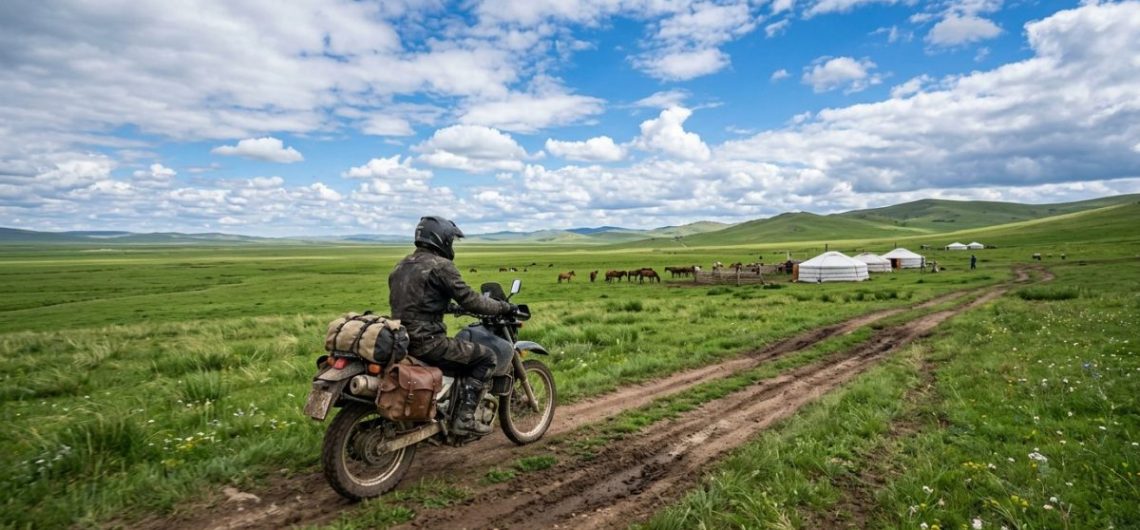
Mongolia’s visa-free welcome for travellers from 34 countries has been extended once more, but only until 1 January 2027, and the last extension was announced on the very day the old one expired. If you are dreaming of the Altai for next summer, here is what the rule says, why it matters for a riding trip, and how to plan a 2027 steppe ride without betting everything on a decision that has not been made yet.
The rule, in one paragraph
Citizens of 34 countries can currently visit Mongolia as tourists without a visa for up to thirty days. The list covers most of the European Union, plus the United Kingdom, Switzerland, Norway, Iceland, Liechtenstein, Monaco, Australia and New Zealand. The exemption was first introduced in 2023 as a temporary measure to boost tourism. It was due to expire at the end of 2025. On 31 December 2025, the government announced it would continue until 1 January 2027. South Korean citizens have their own, more generous arrangement, with stays of up to ninety days until the end of 2026, and some other nationalities, including citizens of the United States, travel under separate, longer-standing agreements.
As with most visa waivers, entry is not quite a blank cheque. It is wise to travel with a passport valid well beyond your stay, proof of a return or onward ticket and details of where you are staying, in case a border officer asks. For anyone arriving on an organised trip, that paperwork is simple. For independent travellers, it is worth carrying printed copies.
Why the date matters so much
Here is the catch for anyone planning ahead. The exemption as it stands runs out on 1 January 2027. Mongolia’s riding season, like its tourist season, is concentrated in the summer, from roughly June to September, with the great Naadam festival in July and the golden eagle festivals of the far west in early autumn. A rider booking a trip for summer 2027 is booking into a period that, as of today, is not covered by the visa waiver.
That does not mean the waiver will disappear. Mongolia has renewed it every time so far, and the government has made clear that it sees easy access as central to its tourism strategy, with its promotional campaign now planned to run until 2028. But the last renewal came on the last possible day, which is not much comfort to someone trying to lock in flights and leave from work six months in advance.
What we tell riders planning 2027
Our advice is simple. Plan the trip as if you might need a visa, and be pleased if you do not. That means checking the visa requirements for your nationality in the months before travel, keeping an eye on announcements from the Mongolian immigration authorities and the country’s embassies around the end of 2026, and leaving enough time between the likely announcement and your departure to apply for a visa if the waiver is not renewed.
For most European and Australian riders, a Mongolian tourist visa, if it comes back, is not a major obstacle. Visas were the norm before 2023, and the application process was manageable. The key is not to be caught out, because a Mongolia trip usually involves long-haul flights, domestic flights and a lot of logistics that are expensive to change at the last minute.
Mongolia is having a boom of its own
The visa waiver is working. Mongolia recorded around 850,000 international visits in 2025, and in the first half of 2026 it welcomed 418,732 foreign tourists, almost twenty percent more than in the same period of 2025 and nearly sixty percent more than in the first half of 2023, the year the waiver started. Most visitors come from Russia, China and South Korea.
For a country of about three and a half million people, almost half of them in the capital, that growth is significant. Ulaanbaatar has more hotels, more flights and more tour operators than a few years ago, and the classic tourist routes around the central steppe and the Gobi are busier in high summer. The far west, where the riding is at its wildest, remains a different world.
The Altai: where the riding is
Our Mongolia ride focuses on the Altai mountains in Bayan-Olgii province, the far western corner of the country where Mongolia meets Russia, China and, just beyond, Kazakhstan. After two days in Ulaanbaatar, the group flies west to Olgii, a three-hour flight across the whole width of the country, and rides from there into a landscape of snow peaks, glaciers, turquoise lakes and huge empty valleys. The Oigor valley, the lakes of Khoton and Khurgan, the Sagsai valley and Tolbo lake mark out a loop through the mountains before the flight back to the capital.
This is a region where the roads are often tracks, where rivers have to be crossed rather than bridged, and where the next fuel stop may be a barrel in a village rather than a pump. It is also home to the Kazakh eagle hunters of western Mongolia, whose tradition of hunting with golden eagles is celebrated every autumn in festivals around Olgii. It is as far from a tour bus as anywhere in Asia.
What riding the steppe actually feels like
It is worth describing, because nothing else in Asia rides quite like it. Outside the few paved highways, the roads of western Mongolia are not roads at all but bundles of tracks, braided across the valleys where every driver has picked a slightly different line. You choose one, it splits, you choose again, and somewhere on the horizon they all meet at a pass or a river crossing. The surface changes every few minutes: hard-packed earth, sand, gravel, washboard ruts that rattle your fillings, and the occasional stretch of grass so smooth you forget you are off-road.
The scale is what stays with you. A valley can take an hour to cross, with nothing in it but a white ger, a herd of horses and a couple of camels watching you with deep disinterest. Marmots whistle and dive into their burrows as you pass. Golden eagles turn overhead. At the end of the day, you look back at a mountain you rode past in the morning and it is still there, filling half the sky. There is a reason riders come back from Mongolia quieter than they went.
Ulaanbaatar, the start and the end
Every trip begins and ends in the capital, and it is worth giving it a day. Ulaanbaatar is a city of contrasts: glass towers and Soviet apartment blocks, ger districts climbing the hills around the centre, heavy traffic and, in winter, some of the worst air pollution of any capital in the world. In summer it is lively and pleasant, with good restaurants, busy squares and a growing café culture.
The Gandan monastery, the most important Buddhist centre in the country, is the place to start, with its giant standing Buddha and its monks chanting in the halls. The national museum explains the history of the steppe empires, from the Huns to Chinggis Khaan. And a short drive east of the city, a colossal stainless steel statue of Chinggis Khaan on horseback stands on the steppe, looking east towards his birthplace. It is not subtle, but nothing about Mongolia’s relationship with its most famous son is.
The Kazakh far west
Bayan-Olgii is unlike the rest of Mongolia. Most of its people are Kazakhs, whose ancestors settled in the Altai generations ago, and the province feels like a different country: Kazakh is spoken more than Mongolian, the towns have mosques as well as the occasional Buddhist stupa, and the food leans towards Central Asia, with boiled mutton and noodles, fresh bread and endless cups of milky tea. Hospitality is serious business, and a visit to a family can easily turn into a meal that lasts all afternoon.
It is also the home of the eagle hunters, men and increasingly women who train golden eagles to hunt foxes and hares in the winter. Meeting a family with their eagles, and watching one of the huge birds settle on a gloved arm, is one of those moments that makes the long flight west feel very short.
Thirty days is plenty, if you plan it
For most riders, the thirty-day visa-free stay is more than enough. A ten-day ride with a couple of days in Ulaanbaatar on either side fits comfortably, as does a longer trip combining a ride in the west with a few days in the central steppe or the Gobi. Where it can get tight is for travellers who want to combine Mongolia with an overland journey, for example by train from Russia or China, or who want to spend a whole summer in the country.
If your plans run longer than thirty days, you will need a visa in any case. And if you are planning a trip that crosses borders by land, check the rules for the specific crossing: not all of Mongolia’s land borders are open to foreigners, and the rules for vehicles are more complicated than for people.
The season, and the weather
Mongolia’s weather is famous for its extremes. In the Altai, summer days can be warm and sunny while nights at altitude drop close to freezing, and snow is possible on the high passes in any month. June is green and fresh, July brings Naadam and the warmest weather, August can bring heavy rain showers that turn tracks into mud and rivers into obstacles, and September is often the most stable month, with clear skies, golden grass and cold nights.
The golden eagle festivals in the Olgii area take place in early October, when the season is already turning cold. They are extraordinary to see, and some riders plan a trip around them, but they are at the very end of the riding window. For most riders, late June to mid-September is the sweet spot.
Why you do not ride the Altai alone
Independent motorcycle travel in western Mongolia is possible, and a few very experienced adventure riders do it every year. But it is a serious undertaking. Navigation is often by GPS track rather than road signs, fuel and spare parts are scarce, mechanical problems can leave you hundreds of kilometres from help, river crossings change with the weather, and mobile coverage vanishes as soon as you leave the valleys. A mistake that would cost an afternoon in Europe can cost days in the Altai.
That is where a guided tour makes the difference: local guides who know the tracks and the rivers, a support vehicle with fuel, spares and food, a mechanic, and relationships with the families whose gers you will stay in. It turns an expedition into a ride, without taking away the wildness that makes it worth doing.
Sleeping in a ger
One of the great pleasures of a Mongolian ride is the accommodation. Outside the towns, most nights are spent in gers, the round felt tents of the nomadic herders, either in tourist camps or with families. A ger is warm, surprisingly spacious and heated by a stove in the middle, which your hosts will light before you go to bed and which will go out, reliably, at about four in the morning.
Staying with herder families is one of the most memorable parts of any trip to Mongolia. You will be offered milk tea, dried curd, and very possibly airag, fermented mare’s milk, which tastes exactly as you imagine it does. Accept it with your right hand, take a sip, and smile. Your hosts have been doing this for centuries, and they are entirely used to the expression on your face.
Flights, fuel and the rest of the paperwork
Most visitors arrive in Mongolia by air, at the new Chinggis Khaan International Airport south of Ulaanbaatar. Domestic flights link the capital with the provinces, including Olgii in the far west, and they are an essential part of any trip that focuses on the Altai. They are also subject to weather delays and tight baggage rules, which is one more reason to leave a spare day at the end of the trip.
For riders, the other paperwork is the usual: a valid motorcycle licence with an International Driving Permit, travel insurance that covers motorcycle riding in remote areas and, ideally, medical evacuation, and a passport valid for at least six months. None of it is unusual, but in a country where the nearest hospital can be a day away, the insurance deserves particular attention.
Packing for the Altai
Mongolia punishes the wrong kit. Pack layers for everything from hot afternoons to freezing nights: a thermal base layer, a warm fleece or down jacket, and a riding jacket and trousers with good ventilation and a waterproof layer. A buff or a light mask for the dust is essential on dry days, when every vehicle ahead of you raises a brown cloud that hangs in the air for minutes. Waterproof boots that you trust in a river crossing are worth more than any gadget.
Bring a head torch, because gers are dark and the toilet is usually a walk away under a sky full of stars. A power bank helps in camps where electricity comes from a small solar panel or a generator for a few hours in the evening. Carry some cash in local currency for small purchases in villages, where cards are often useless. And bring patience, which Mongolia will consume in large quantities and repay with interest.
A region of temporary welcomes
Mongolia is not the only country in the region offering visa-free entry on a temporary, renewable basis. China’s unilateral visa-free policy for most European passports also runs until the end of 2026, and Vietnam’s exemptions for European countries run until 2028. Governments across Asia have discovered that removing visas brings visitors, and most of them have kept renewing their waivers. But temporary means temporary, and anyone planning a multi-country ride for 2027 should check each country’s rules again in the weeks before booking flights, rather than relying on what worked last year.
Fuel deserves one more line. Outside the provincial centres, filling stations are few and far between, and the quality of the fuel can vary. On a guided ride, the support vehicle carries extra fuel and the route is planned around the reliable stations. On an independent trip, range becomes the single biggest planning constraint, and a bike that manages three hundred kilometres on a tank is suddenly worth a great deal more than one that looks good in photographs.
What would change if visas come back
If Mongolia does not renew the exemption, the main change would be a visa application before travel, with the associated fee, paperwork and waiting time. It would not stop anyone who really wants to ride the Altai. But it would add cost and friction, and it could cool the growth that the country has enjoyed since 2023. Given how clearly the government has tied the waiver to its tourism strategy, a renewal in some form looks more likely than not, but it is not guaranteed.
The honest position, as of the end of September 2026, is that nobody outside the Mongolian government knows for sure. The sensible approach is to plan the trip, book early, and keep the visa question on your calendar for the end of the year.
Riding Mongolia for real
The 10-day Mongolia Wild West Ride takes you from Ulaanbaatar to Olgii and into the Altai mountains, with local guides, a support vehicle, a mechanic, nights in ger camps and a visit to a Kazakh eagle hunter family. It is a motorcycle tour to the far edge of the map, run as a guided tour so that the only surprises are the good ones.
Planning the steppe for 2027? Ask us on WhatsApp or at info@bigbiketours.com. We follow the visa decision closely and will tell you what we know for your passport, well before a big biking tour in the Altai becomes a last-minute scramble. It is the wildest motorbike tour we run, and it deserves to start calmly.
 English
 Deutsch
 Español
 Français
 Italiano
Comments