

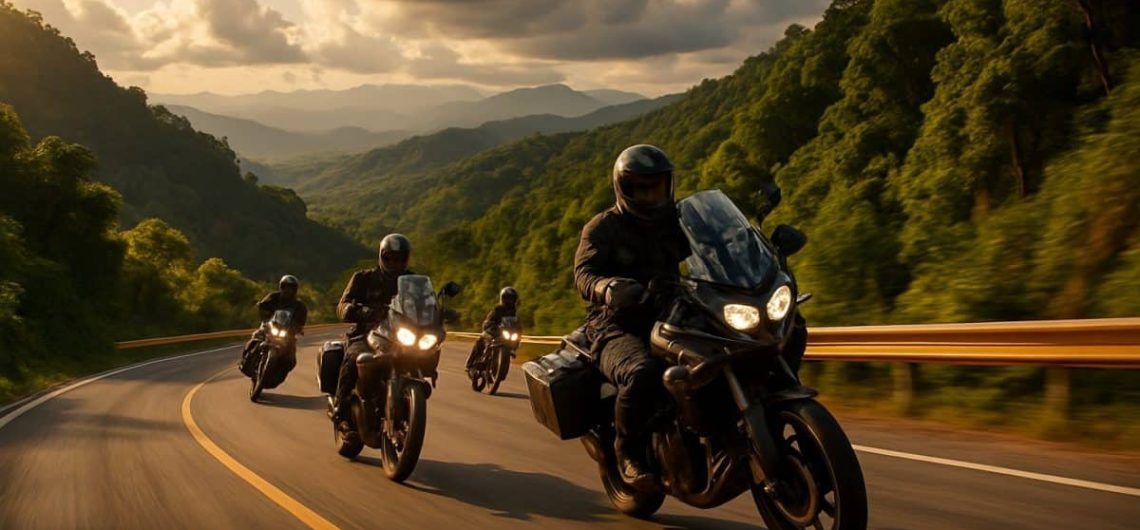
There are two kinds of motorcycle people in this world. The ones who ride, and the ones who also love watching the fastest humans alive do it on machines that cost more than a house. If you happen to be both — and most of us secretly are — then Buriram in early spring is the closest thing our sport has to a pilgrimage. Once a year the quiet rice-farming province in Thailand’s northeast turns into a screaming, flag-waving cathedral of two-stroke nostalgia and four-stroke fury, and riders fly in from every continent to be there. This is the story of how you turn that one weekend into the trip of a lifetime, by earning your grandstand seat the only way that really counts: with a tankful of fuel and a thousand corners behind you.
Why Buriram became the place every rider wants to be
Buriram was not always on the map for motorsport. For most of its history it was known for rice, ancient Khmer temples, and a football team. Then in October 2014 the Chang International Circuit opened its gates — the first FIA Grade 1 and FIM Grade A track in the whole country, designed by Hermann Tilke, the German architect behind half the modern Formula 1 calendar (Wikipedia). The build cost around two billion baht and could swallow a hundred thousand fans across its grandstands and grass banks. Almost overnight, a sleepy province became the beating heart of Asian racing, and the locals have never looked back.
A track that punishes show-offs and rewards bravery
The Grand Prix layout runs 4.554 kilometres across twelve turns, and it is sneakier than the numbers suggest. Long straights tempt riders into thinking it is a simple drag race, then a brutal heavy-braking zone at the end of the back straight separates the heroes from the optimists. The 2026 MotoGP lap record belongs to Marco Bezzecchi on the Aprilia at 1 minute 30.487 (Wikipedia), and watching the leaders fling a 350-kilometre-an-hour missile into that braking zone, knee and elbow scraping the tarmac, rearranges something in your chest. Marc Márquez tamed this place to win the very first two editions in 2018 and 2019, and the crowd has adored the circuit ever since.
The race that now opens the whole season
Here is the part that makes Buriram special for travellers. The Thailand Grand Prix has been promoted to the season opener, which means the entire racing world descends on this one circuit to kick off the championship. The 2027 round is scheduled for the final weekend of February into the first day of March — roughly the 25th of February to the 1st of March 2027 (MotoGP.com). The deal keeps the race in Thailand through at least 2031, so this is not a fad. Because the date is fixed by the calendar and not by your mood, this is the one trip you genuinely cannot leave until the last minute — book late and the grandstands are already full.
Why a race weekend alone leaves you hungry
Plenty of fans fly into Bangkok, take a short hop to Buriram, sit in the stands for three days, and fly home. Nothing wrong with that. But ask any of them on the flight back and they will admit something felt unfinished. You came all the way to Thailand — a country stitched together by some of the best riding roads on earth — and you spent the whole time standing still. That is like flying to Naples and eating at the airport. The race is the headline, sure, but treating it as the whole story wastes the country wrapped around it. The smart move is to make the riding the main course and the race the dessert.
Enter the long way round
This is exactly the thinking behind the Long Way Round, a twelve-day guided tour built by Big Bike Tours that refuses to simply shuttle you to the circuit. Instead of blasting down the highway, it loops you across the north and the northeast first — border roads, mountain passes, ancient capitals — so that by the time you roll into Buriram you have actually earned the place. Eleven nights in proper hotels, every breakfast, lunch and dinner sorted, fuel paid, bikes maintained, and a TAT-licensed road captain leading the way. You arrive at the grandstand smelling faintly of two-stroke and triumph, not jet lag.
Day one starts on the Roof of Thailand
The trip warms up where every great northern ride should, climbing Doi Inthanon, the highest peak in the country at 2,565 metres (Wikipedia). The air up top is cool enough to fog your visor, and the twisty climb shakes the long flight out of your arms. Take Dietmar, a 58-year-old dentist from Stuttgart who arrived convinced his fitness would be a problem on a long motorcycle tour — by lunchtime on the mountain he had forgotten he was nervous and was grinning into his coffee. The Vachiratharn waterfall thunders nearby, and the day ends with your legs remembering what a real riding position feels like.
The lonely roads near Myanmar
From the mountains the route slips west toward the Thai–Myanmar border, through Mae Sariang and along the Salawin River, where the traffic thins out to almost nothing and the tarmac belongs to you. This is the kind of riding that converts people. Consider Priscilla, a London paramedic who books a big trip every year to reset her head — she described the border road as the first hour in months her brain went completely quiet. The villages out here see a group of touring bikes maybe a few times a month, so children sprint to the roadside to wave. It is the unglamorous, unhurried middle of a country that most tourists never reach.
Mae Sot and the slow reveal of the northeast
The road tips you down into Mae Sot, a scruffy, lively border town that feels more like a frontier outpost than a tourist stop, and that is exactly its charm. From here the character of the trip shifts. The dramatic mountains soften, the horizons open, and you start the long, satisfying drift toward Buriram. Riders who only know the postcard north are often surprised by this stretch. Kwabena, a Ghanaian engineer based in Dubai, had ridden Thailand twice before and never once left the famous loops — he said this section finally showed him the country breathing, away from the selfie crowds.
Standing inside a thousand-year-old kingdom
Then comes Sukhothai, the first capital of old Siam and a UNESCO World Heritage Site, where you wander among the serene stone Buddhas and crumbling temples of a kingdom that flourished seven centuries ago (UNESCO). Walking a motorcycle slowly past these ruins at dawn, with the morning mist still hanging in the moat, is the sort of moment that makes a guided tour worth every baht. Yuki, a graphic designer from Osaka, admitted she had only signed up for the racing and was blindsided by how moved she felt here. The history is not a sideshow on this trip — it is woven right through the riding.
Through the Tak pass toward race country
The Tak mountain pass throws one last proper set of curves at you before the land flattens into the wide farmland of Isaan, Thailand’s vast and underrated northeast. The pace here is about rhythm, not adrenaline — long sweeping roads where you settle into the saddle and let the kilometres dissolve. This is where a motorbike tour stops feeling like a holiday and starts feeling like a way of living. Federico, a Bolognese mechanic who had watched every Grand Prix on television since boyhood, said it was somewhere along this stretch that the reality finally hit him: he was actually going to see his heroes in the flesh.
The Khao Yai detour nobody expects
Before the circuit, the route swings near the Khao Yai National Park region and the Lam Phra Phloeng Reservoir, a green and hilly pocket that feels a world away from the dusty plains. It is a clever bit of route-building, because it keeps the riding interesting right up until the moment the trip changes gear entirely. Naomi, a Toronto nurse who joined mostly to keep her race-mad husband company, found herself the one begging to stop for photos here. By now the group has gelled — twelve days in the saddle does that — and the anticipation of the race is humming through everybody like a held breath.
And then, Buriram
You roll into Buriram and the whole atmosphere shifts. The town is dressed in racing colours, the bars are full of riders from forty countries, and the sound of engines drifts in from the circuit on the warm evening air. This is not just watching racing — it is being absorbed into a global gathering of people who love exactly the same daft, brilliant thing you do. Big Dave, a 61-year-old former dispatch rider from Birmingham, said the paddock at Buriram felt more like home than his actual street. The shared language of motorcycles needs no translation, and for one weekend this small Thai town speaks it fluently.
Race day, from a seat you earned
When the lights go out on Sunday and twenty-two bikes howl down to that first corner, the noise hits you in the sternum before your ears even register it. You will have ridden roughly a thousand kilometres of real Thai roads to reach this seat, and that changes how you watch. You are not a tourist gawping at a spectacle — you are a rider who understands, in your hands and wrists, what those racers are actually doing. Federico, our Bologna mechanic, admitted he cried a little when the season finally launched in front of him. His new friend Lukas, a Berlin barista who came only for the riding, surprised himself by becoming the bigger fan by Sunday afternoon.
The ride home is the secret best part
Most race packages end at the chequered flag. This one does not, and that is the masterstroke. After Buriram the tour turns north along the Mekong, threading through Khon Kaen, Udon Thani and Nong Khai before reaching the sleepy riverside village of Chiang Khan, where you watch the sun drop over Laos with a cold drink and zero agenda. The decompression after the race is something fly-in fans never get. Sefton, a Cardiff paramedic who lives for riding density, said the post-race days felt like the trip exhaling, the perfect comedown from the weekend’s chaos.
Saving the best road for last
As if to prove it has been holding back, the route then climbs into Nan province for the grand finale: the legendary Route 1148, a ribbon of mountain tarmac that riders quietly argue is the finest road in the country, plus the wild switchbacks of Route 1081 and the salt wells of Bo Kluea. Tomás, a Lisbon courier who lives for lean angle, had spent the whole trip patiently waiting for this section and described it as the best two hours of riding in his life. Doi Phu Kha National Park and Phayao Lake round things out before the road carries you home, and by then you understand why this is structured as a full big biking tour and not a quick airport shuttle.
Twelve days that fix something in your head
There is a particular magic to a trip this length. The first couple of days you are still half at work in your mind, checking your phone, sleeping badly. By the middle your gear has found its place, your riding has smoothed out, and the road has stopped being a novelty. Gerald, a 63-year-old retired teacher from Perth, said the Long Way Round taught him he was a far more capable rider than his commute had ever let him believe. That is what twelve real days on a bike do — they show you who you are at hour six of day nine, and usually you like the answer more than you expected to.
What it actually costs you to worry about (nothing)
The quiet luxury of this kind of trip is everything you do not have to think about. The bikes are well maintained and run on unlimited mileage, fuel and oil are covered, the hotels are booked, almost every meal is paid, and there is a mechanic and a support van trailing the group for the rare day something goes sideways. Wei, a Singapore engineer allergic to wasting money, built a spreadsheet comparing this against winging it solo and was stunned how close the numbers landed once he counted his own time and the inevitable mishaps. You give up a little spontaneity and you get back a lot of headspace — which, on a race pilgrimage, is exactly the trade you want.
Who this trip is really for
You do not need to be a racer to love this, but you do need to enjoy spending real days in the saddle, because there is genuine distance here. Confident riders with a few seasons behind them will be in heaven. Newer riders who can handle a full day’s riding will be stretched in the best way, with a road captain setting a sensible pace and a sweep rider making sure nobody is left behind. If you are still building confidence, our guide on how complete beginners master Thai roads is worth a read first. And if you are torn between this and the country’s other classic routes, the honest breakdown in which Thailand tour suits you lays it all out.
When to ride and why timing is everything here
Most Thailand trips give you flexibility on dates. This one does not, and that is the whole point — the race calendar decides for you, landing the trip in the cool, dry tail of the northern winter, which happens to be the finest riding season of the year. Crisp mountain mornings, firm roads, comfortable temperatures: you could not script a better window. Annika from Oslo, who once booked a Thai trip almost by accident in the perfect season, said the timing was a gift she had not even known to ask for. With Buriram, the calendar hands you the best weeks of the year whether you planned it or not.
A word on the bike under you
People obsess over the destination and forget the machine, which is backwards. The good news is the fleet is built for these roads — grippy northern tarmac, the odd patched landslip, long Isaan sweepers — so you are not gambling on a tired rental with bald tyres. Omar, a Cairo rider with long legs and a sore back, fretted for weeks about bike fit and then forgot all about it within an hour because the machine actually suited him. The bike should disappear underneath you so the country, and then the racing, can take centre stage. On a trip with this much variety, that pairing matters more than the badge on the tank.
The stories you bring home
What nobody tells you about a ride-and-race trip is that the racing, as electric as it is, rarely tops the list of stories you tell afterward. It is the border road where your brain went quiet, the dawn at Sukhothai, the cold beer over the Mekong, the impossible curves of Route 1148. The race is the spark, but the journey is the fire. Beatriz, a vet from Porto who came for the spectacle, went home talking mostly about the people she rode beside. That is the strange alchemy of doing it this way — you arrive a fan and you leave a traveller.
What trackside actually feels like
Television flattens everything. It cannot carry the way the air shudders when the pack thunders past, or the smell of hot brakes and fried noodles drifting through the grandstand, or the roar of a hundred thousand people losing their minds when a Thai rider grabs a points finish. The grass banks fill with families, the stands turn into a sea of team colours, and strangers hand you snacks you cannot name. Carla, a São Paulo dentist who had only ever followed the sport online, said her first lap trackside made every race she had watched at home feel like a black-and-white photo of the real thing. You feel the racing here. You do not just see it.
The crew that quietly has your back
The thing that lets you switch your brain fully into holiday mode is the team riding with you. A TAT-licensed road captain leads the group and knows every viewpoint, fuel stop and dodgy junction on the route, while a support van shadows the ride carrying luggage, cold drinks, and a spare seat for anyone who fancies a break. Across twelve days and well over a thousand kilometres, that safety net matters. Hans and Greta, a retired couple from Hamburg riding two-up on a big adventure bike, said the quiet confidence of having pros around them was what let them relax and actually look at the scenery instead of the map.
Packing for heat, hills and a race weekend
The cool season is kind, but Thailand still throws variety at you: chilly dawns on Doi Inthanon, baking afternoons on the Isaan plains, and a sun-soaked grandstand on race day. Light layers you can stash in the van are your friend, and the company supplies quality helmets, jackets, gloves and knee guards if you would rather travel light. Diego, a carpenter from Seville who swore he would never trust a loaner lid, ended up borrowing a jacket on day two and forgot it was not his own. Bring your own boots and earplugs, pack sunscreen like you mean it, and let the support van carry everything else.
How it stacks up against the big loops
If you are weighing this against the country’s marathon routes — the twenty-day Great Thailand Ride, say — the difference is the hook. Those trips are about the riding, full stop. This one wraps the riding around a fixed, once-a-year event, which gives the whole journey a heartbeat and a deadline. For race fans that focus is the entire appeal. The Lindqvist brothers from Stockholm, who had already done a long loop years earlier, chose the MotoGP trip specifically because it gave their reunion a reason and a date on the calendar. Same great roads, but pointed at a finish line that screams.
Ready to earn your grandstand seat?
The fastest riders on the planet will be lining up at Buriram, and you can either watch from your sofa again or finally go and feel that first-corner roar rattle your ribs in person. The Long Way Round – MotoGP Thailand trip blends twelve days of serious riding with a ticket to the greatest show in motorcycling, all run by professional road captains in small, friendly groups. Because the race dates are locked, the only real question is whether your seat will still be there when you decide. Take a look at the full MotoGP Thailand tour, pick your year, and come earn the best weekend in racing the way it was always meant to be earned — on two wheels.
 English
 Deutsch
 Español
 Français
 Italiano
Comments