

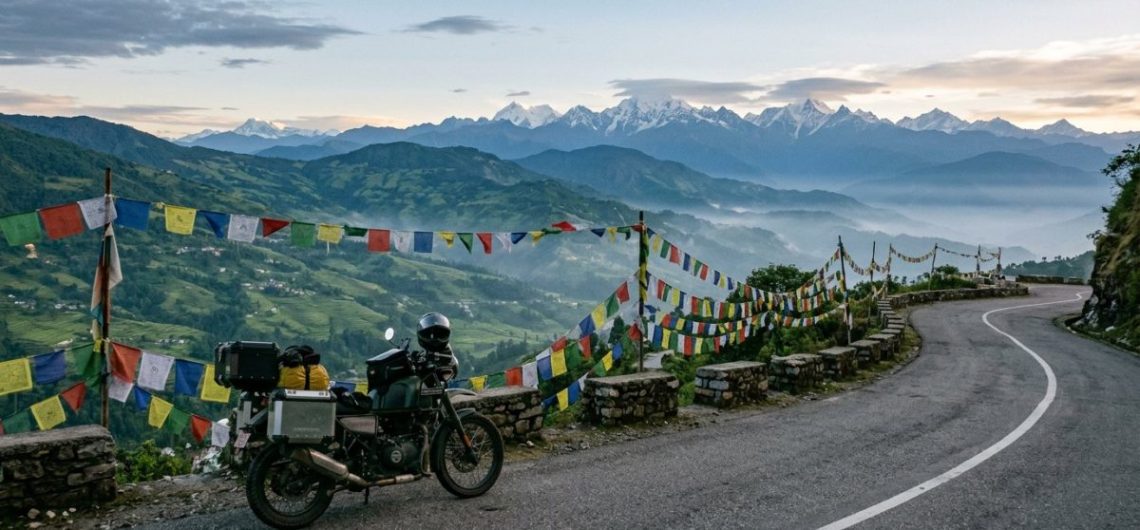
A year ago, young Nepalis brought down their government. In March they elected a new one, led by a 35-year-old former rapper. And on 26 August, a huge slab of ice and rock collapsed from Langtang Lirung and sent a wall of debris down into the Trishuli river, in the country’s deadliest disaster since the 2015 earthquake. Here is where Nepal stands at the start of its autumn season, what it means for anyone planning to ride there, and why the honest answer is more careful than a brochure would like.
A year that turned the country upside down
On 8 September 2026, families in Kathmandu lit oil lamps and laid fruit and flowers in memory of the young people killed a year earlier. In September 2025, protests led by students and young Nepalis against corruption and a ban on social media platforms escalated into violence. Security forces opened fire, dozens of protesters were killed, government buildings and politicians’ homes were set on fire, and Prime Minister K. P. Sharma Oli resigned. A former chief justice, Sushila Karki, led an interim government through six months of transition.
The election on 5 March 2026 finished the job the protesters started. The Rastriya Swatantra Party won 182 of the 275 seats in the House of Representatives, sweeping aside the parties that had dominated Nepali politics for decades. On 27 March, Balendra Shah, known to everyone as Balen, a former mayor of Kathmandu, engineer and rapper, was sworn in as prime minister at 35, the youngest the country has had in decades and the first from the southern Madhes region. His party’s programme puts tourism high on the list, with promises of better air connections, better infrastructure and a wider offer beyond mountains and trekking.
Then the mountain came down
The new government had barely settled in when the country was hit by catastrophe. On 26 August, a huge mass of ice and rock broke away from the northern side of Langtang Lirung, one of the peaks north of Kathmandu, and fell hundreds of metres into the valley of the Lhende Khola, on the far side of the mountain from the famous Langtang trekking valley. The collapse was strong enough to register as a seismic event. It briefly dammed the Lhende Khola, then a debris flow raced down through the Bhote Koshi and into the Trishuli river, which flows from the Tibetan border through the districts of Rasuwa, Nuwakot and Dhading towards Gorkha and Chitwan.
The toll is staggering. By 24 September, according to AFP, 1,451 people had been confirmed dead in Nepal and 43 across the border in China. In mid-September more than 5,600 people were still listed as missing and nearly 7,000 had been injured. About 7,570 houses were destroyed, along with dozens of bridges, some seventy kilometres of road and a string of hydropower plants. The border crossing at Gyirong, one of the main trade routes between Nepal and China, was destroyed. The United Nations called it the deadliest natural disaster in Nepal since the earthquake of 2015.
The road to Pokhara, cut for two weeks
For anyone who has travelled in Nepal, the most tangible effect was on the Prithvi Highway, the main road from Kathmandu to Pokhara and the west, which follows the Trishuli river for much of its length. On 30 August, at Krishnabhir in Dhading district, around a hundred metres of road collapsed into the swollen river, and the highway was cut. Around 14,000 vehicles a day normally use it. For two weeks, they could not, and Kathmandu ran short of cooking gas as tankers were stuck on the wrong side of the break.
On 13 September, one-way traffic resumed on a new track cut through the hillside around the collapsed section, and two-way traffic followed on 17 September. Fresh rain then pushed it back to one-way operation from 19 to 24 September. It is a remarkable piece of emergency engineering, and it means the main artery between the capital and Pokhara is working again, but fragile. It also means that the stretch along the Trishuli will be a construction zone for a long time, with temporary surfaces, heavy trucks and a river that has shown exactly what it can do.
September’s rains did not help
Nepal’s monsoon did not simply end after the August disaster. In the last week of September, heavy rain triggered more than three hundred landslides across the country, killing at least twenty-one people. That is, sadly, not unusual for the tail end of the monsoon in the Himalaya, but it came on top of a landscape already destabilised by the August floods, with thousands of people still displaced and rescue work still going on in the worst-hit valleys.
The autumn season, from October to November, usually brings clear skies, dry roads and the best mountain views of the year. It is the peak season for trekking and for riding. This year it begins in the shadow of a national tragedy.
What a glacier collapse means for the Himalaya
The Langtang disaster was not a glacial lake bursting, the kind of Himalayan flood that has been discussed for years. It was a slab of ice and rock breaking away from a mountainside and falling into a valley, turning into a torrent of debris that moved at tens of metres a second. Scientists have been warning that warming temperatures are destabilising ice and permafrost on steep Himalayan slopes, making such collapses more likely. The UN’s climate chief put it bluntly after the disaster, saying that a warming climate is making tragedies like this more likely, more frequent and more severe.
For anyone who travels in the high Himalaya, that is a sobering thought. The mountains we ride through for their beauty are changing fast, and the valleys below them carry risks that did not exist in the same way a generation ago. It does not mean staying away. It means paying attention to local warnings, respecting closures and choosing operators who treat the mountains as a living, moving environment rather than a backdrop.
Kathmandu, a city that has seen worse
Kathmandu itself was not in the path of the flood, although it felt the consequences. With the Prithvi Highway cut for two weeks, the capital ran short of cooking gas and some goods, and prices rose. Hospitals in the city took in many of the injured from the affected districts. By the end of September, with the highway reopened, daily life in the valley was back to its usual noisy, dusty, fascinating self.
The great sights of the valley, the old royal squares of Kathmandu, Patan and Bhaktapur, the stupa of Boudhanath with its watching eyes, the hilltop temple of Swayambhunath with its monkeys, were far from the flood zone. Many of them still carry the scars and the scaffolding of the 2015 earthquake, and they are a reminder of how much this country has rebuilt before. A day or two in the valley before a ride is still one of the best introductions to Asia anyone could ask for.
The Kailash question
The destruction of the Gyirong border crossing has a consequence that reaches beyond Nepal. The crossing at Rasuwagadhi and Gyirong was the main road route from Kathmandu into Tibet, used by pilgrims heading to Mount Kailash and by overland travellers. Pilgrims were caught at the crossing when the flood hit, and the route has been cut. Anyone planning an overland journey from Nepal into Tibet should assume that route will not be available for a long time.
For riders, it is another reason why Tibet trips are best planned from the Chinese side, flying into Lhasa, rather than overland from Kathmandu. That was already the more practical option for most itineraries, given the permits and paperwork involved. After August, it is effectively the only one.
So, should you go?
This is where honesty matters more than enthusiasm. Nepal is not closed. Kathmandu, Pokhara, the Kathmandu valley, the lakes and hills around Pokhara, the Annapurna region, Mustang and the south-west were not the centre of the August disaster. Tourists are still arriving: in August, the month of the disaster, Nepal recorded 85,444 international visitors, only a few percent fewer than a year earlier, with India the biggest market and Chinese arrivals up by more than a third.
But some areas are not places for visitors right now. The upper Trishuli valley, Rasuwa and the Langtang region are disaster zones where people are still searching for the missing, rebuilding homes and burying the dead. They need rescuers, engineers and aid, not holidaymakers. For the rest of the country, the question is less whether it is safe to visit and more how to visit in a way that helps rather than gets in the way.
Why tourism matters now more than ever
Nepal’s economy depends heavily on tourism and on money sent home by Nepalis working abroad. After a year of political upheaval and a disaster whose damage was first estimated at around 400 billion rupees, with recovery needs later put at some 723 billion, the tourism season that starts in October is not a luxury for the country. It is a lifeline for hotel owners in Pokhara, guides in Mustang, drivers in Kathmandu and the families behind them.
That is not a sales pitch. It is the view of almost everybody in the Nepali tourism industry, and it is the same argument that was made after the 2015 earthquake, when many visitors stayed away out of respect and the people they wanted to spare lost their income. Travelling responsibly, to the areas that are open and functioning, spending money locally and staying away from the disaster zones, is the most useful thing a visitor can do this autumn.
What changes on a ride through Nepal
Our 14-day Nepal ride leaves Kathmandu towards Bandipur and Pokhara, heads north into Mustang between the Annapurna and Dhaulagiri massifs, comes back through the hot springs of Tatopani and down the Siddhartha Highway, and finishes with a safari in Chitwan before returning to Kathmandu. The stretch of the Prithvi Highway along the Trishuli, including the section that was cut this summer, is covered on the tour as a transfer rather than ridden, and Chitwan district was among those affected by the floods.
For the coming season, the sensible approach is simple. Allow extra time for the transfer along the Trishuli, on a road that is open but repaired rather than restored. Check conditions every day, because the landslides of late September show how quickly things can change. And where a section is not appropriate for a group of riders, whether because of damage or because it is in the middle of relief operations, change the route rather than push through. Any operator worth riding with in Nepal this autumn should think the same way.
Riding the new Nepal
It is worth remembering what draws riders to Nepal in the first place, because none of it has gone away. The road from Pokhara into the Kali Gandaki gorge, between two of the highest mountains on earth, is one of the great rides of Asia. Mustang, with its red cliffs, whitewashed villages and Tibetan monasteries, feels like a different world. The hills of Bandipur, the lakes around Pokhara, the old towns of the Kathmandu valley, and the jungle of Chitwan give a riding holiday in Nepal a range few countries can match.
The roads are rough, the traffic is chaotic, and riding here asks for patience and skill. That was true before the disaster and it will be true after it. Royal Enfields, the classic bike of the Himalaya, are the natural choice, and there is something very right about riding one into Mustang with the Annapurnas on your right.
The riders you will share the road with
Nepal’s roads have their own motorcycle culture, and it is one of the pleasures of riding there. Indian riders cross the open border in large numbers, many of them on their own bikes with the customs permit known locally as a bhansar, heading for Pokhara and Mustang on the trip of a lifetime. Nepali riding clubs from Kathmandu and Pokhara head into the hills at weekends on everything from small commuter bikes to big adventure machines. At the tea houses in the Kali Gandaki gorge, you will often find more riders than trekkers, comparing routes, tyres and the state of the road above Jomsom.
Those conversations are the best source of up-to-date information you will find, especially this season. A rider who came down from Mustang yesterday knows more about the road than any website. And after a year like this one, the sense of shared adventure among riders from different countries, gathered around a pot of tea in a stone lodge with the Dhaulagiri glowing outside, feels more valuable than ever.
The politics, from a visitor’s point of view
For visitors, the change of government has so far brought stability rather than disruption. The new prime minister came to power with a huge majority and a mandate to fight corruption and modernise the country. His government’s early months were dominated first by forming a cabinet and then by the disaster response. The anniversary of the uprising in September was marked by commemorations rather than unrest.
Australia lowered its travel advice for Nepal to its second level shortly after the elections, well before the August disaster. Anyone travelling this autumn should check the latest advice from their own government, which will focus on the flood-affected areas and on the usual monsoon risks rather than on politics. The practical reality for most visitors is a country that is calm, welcoming and grieving.
How to help, if you want to
Many riders who love Nepal will want to do something beyond simply visiting. The most effective help usually goes through established organisations working on the ground, including the United Nations agencies, the Red Cross and reputable Nepali organisations, which know how to get support to the right places. Well-meaning individuals turning up in disaster zones with good intentions and no plan tend to add to the burden on overstretched local services.
On the road, the help is simpler. Stay in locally owned guesthouses, eat in local restaurants, hire local guides, pay fair prices without haggling over tiny amounts, and be patient when things take longer than planned. In a country where so many families have lost so much, a visitor who is kind, flexible and generous makes a real difference.
Timing and paperwork
Most visitors can get a tourist visa on arrival in Nepal or apply online in advance. For riding, you will need your home motorcycle licence and an international driving permit, and travel insurance that covers motorcycle riding at the engine size you will use and at the altitudes you will reach, since the road into Mustang climbs to around 2,700 metres at Jomsom and higher beyond. Buy the insurance when you book, and check what it says about natural disasters and known events, because the August floods may already fall into that category for new policies.
The best months for riding are October and November, after the monsoon and before the cold, and again in spring, from March to early May. This year, the first weeks of October may still bring rain and landslides, so later in the autumn is the safer bet. If your dates are flexible, November is likely to be the most reliable month of the season.
Riding Nepal for real
The 14-day Nepal Mustang ride runs from Kathmandu to Pokhara, into Mustang, down the Siddhartha Highway and on to Chitwan, on Royal Enfields, with an English-speaking guide on his own motorcycle, an experienced mechanic and a support vehicle for luggage and pillions. It is a guided tour for riders who want to see Nepal properly and support it while they do. See our Himalayan motorbike tours page for more.
Thinking about Nepal this season or next spring? Ask us on WhatsApp or at info@bigbiketours.com. We will tell you honestly which weeks make sense, which roads are open and how a motorcycle tour can be part of the recovery rather than a burden on it. A big biking tour in Nepal this year is about more than the road, and that is exactly why the right motorbike tour matters.
 English
 Deutsch
 Español
 Français
 Italiano
Comments