

A Chinese-built railway opened alongside the old road and took most of the freight off it. What that did to Route 13 north of Vang Vieng is the best thing to happen to riding in Laos in twenty years, and almost nobody has noticed.
The road everyone used to warn you about
Route 13 is the spine of Laos. It runs the length of the country, from the Chinese border in the north down through Luang Prabang, Vang Vieng and Vientiane and on to the Cambodian frontier, and for most of its existence it has carried everything the country moves.
The northern section, the mountain stretch between Vientiane and Luang Prabang, has a reputation among riders that is part legend and part warning. Spectacular, with hundreds of kilometres of ridge running and switchbacks through karst country. Also, until recently, choked with heavily overloaded trucks grinding up gradients at walking pace, shedding diesel on the corners and taking the whole width on blind bends.
The riding was worth it and the trucks were the tax you paid for it.
What the railway did
The Laos-China Railway opened in late 2021, running from Boten on the Chinese border through Luang Prabang and Vang Vieng to Vientiane. Four hundred and something kilometres, most of it in tunnels and on viaducts because of the terrain, built with Chinese capital and Chinese engineering.
Its purpose was freight as much as passengers: a standard-gauge line connecting southern China to the Thai network, turning a landlocked country into what the government hopefully calls land-linked.
The effect on the road was immediate and it is the part that matters here. A substantial share of the freight that used to grind up Route 13 in a truck now goes through a mountain in a container. The heavy long-haul traffic between the Chinese border and Vientiane has thinned considerably.
What is left on the road is local traffic: pickups, buses, motorcycles, the occasional truck serving a town the railway does not stop at. Which means the ridge sections north of Vang Vieng now ride the way they always should have.
What the road is actually like now
Between Vientiane and Vang Vieng the road is unremarkable and increasingly built up, with an expressway alongside it that carries most of the fast traffic. This is transit.
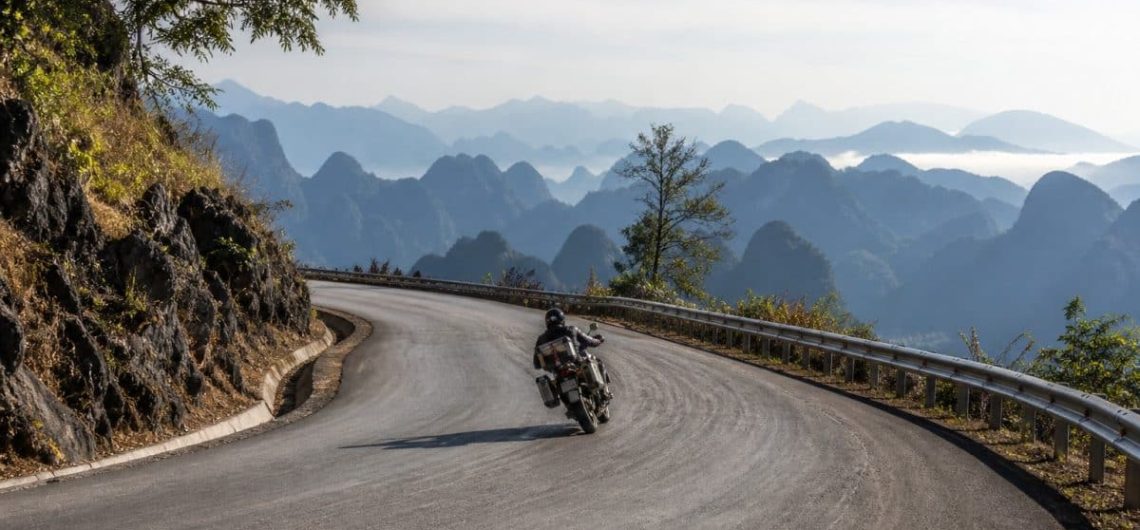
North of Vang Vieng it changes. The road climbs into limestone karst country and starts running along ridges, with the valleys dropping away on both sides and villages strung along the crest because the crest is the only flat ground. There are stretches where you can see thirty kilometres of road ahead of you laid out along a ridgeline.
The surface is variable and honest: good asphalt for long sections, patched sections, and places where a slip has been cleared and the repair is gravel. Landslides during and after the wet season are routine and clearance can take days.
Then the descent into Luang Prabang, which is one of the more satisfying arrivals in Southeast Asia: down out of the mountains into a river valley with the old town sitting at the confluence of the Mekong and the Nam Khan.
Route 4A and the road to Nong Khiaw
The other road worth naming, and the one riders who have done Laos twice tend to prefer.
Route 4A, sometimes signed as the 1C depending on which map you believe, runs east and north from the Route 13 corridor toward Nong Khiaw and Muang Ngoi in the Nam Ou valley. It is narrower, quieter and considerably more spectacular, threading between limestone towers that come straight out of the valley floor.
Nong Khiaw itself is a village on a river between two walls of karst, reached by a bridge with a view that stops people. It has become a backpacker stop without becoming a resort, and it is one of the more pleasant places in the country to spend a night.
The road surfaces up there are worse and the traffic is almost nonexistent. It is the trade that defines riding in Laos: every step away from the main corridor costs you tarmac and buys you emptiness.
The dams, which have changed the rivers
Worth knowing because it explains landscapes that look odd.
Laos has pursued hydropower aggressively, with the aim of exporting electricity to Thailand and Vietnam, and the Nam Ou in particular has been extensively dammed. Sections of river that were fast and rocky are now reservoirs, villages have been relocated, and the boat routes that used to be the main way of moving up that valley have changed or disappeared.
The result for a rider is a series of new lakes in valleys that were rivers, some new roads built for construction access, and some old routes that no longer make sense.
It is also the single biggest environmental argument happening in the country, and it is directly connected to the railway: both are infrastructure built with Chinese finance, both are meant to earn foreign currency, and both have generated a debt burden that Laos is visibly struggling with.
Fuel, which is the planning constraint
Laos has always had a thinner fuel network than its neighbours and it has had genuine supply problems in recent years, with periodic shortages and queues at stations even in the capital.
For a rider the discipline is straightforward and non-negotiable: fill at every opportunity above half a tank. Do not ride past a station in northern Laos because you have a hundred and fifty kilometres of range left, because the next station may be closed, dry, or further away than the map suggests.
Octane is low and quality is variable. A modern injected engine copes by running leaner and losing a little power. What it does not cope with is water or sediment, so a funnel with a filter belongs in the support vehicle on any Laos route.
The support vehicle carrying jerrycans is the difference between planning a day around the riding and planning it around the pumps.
The unexploded ordnance problem
Laos is the most heavily bombed country per capita in history. Between 1964 and 1973 something over two million tonnes of ordnance was dropped on it, much of it cluster munitions, and a substantial proportion failed to detonate.
That legacy is still killing and maiming people, predominantly farmers and children, decades later. Clearance work continues and is nowhere near complete.
For a visitor the practical rule is short: stay on roads, tracks and marked paths. Do not walk into fields, do not pick anything metal up, and do not go poking around interesting-looking scrap. The areas most affected are in the east and along the old Ho Chi Minh trail corridor rather than on the northern Route 13 axis, but the rule applies everywhere.
The visitor centres in Vientiane and Luang Prabang explain it properly and are worth an hour.
Luang Prabang, and why the rest day is there
The old royal capital sits on a peninsula between two rivers, it is a UNESCO World Heritage site, and it is one of the most pleasant towns in Southeast Asia to spend a day not riding.
What makes it work is the density: French colonial buildings and Lao temples in the same streets, a morning market, the Mekong at the bottom of every side road, and a scale you can walk in an afternoon.
The alms-giving procession at dawn, when the monks walk the streets to receive food, has become a tourist spectacle in a way that is uncomfortable to watch. If you go, stay well back, do not use flash, do not stand in the way, and consider whether watching at all is the right call.
The waterfalls at Kuang Si, half an hour out of town, are the other fixture: terraced turquoise pools you can swim in, and a genuinely good ride out and back.
Crossing into Laos, and the visa question
Most riders enter Laos from Thailand at Chiang Khong and Huay Xai, over the Mekong friendship bridge, which is a straightforward crossing where a visa on arrival is available for most nationalities.
Not every crossing offers that. Some of the smaller posts do not issue visas on arrival at all, which is why on our longer multi-country routes the passports go to an embassy in advance for the second crossing rather than being presented at the barrier. That is exactly the sort of detail that is invisible when somebody has handled it and ruinous when nobody has.
The bike needs paperwork too: a temporary import document tied to the frame number, which for a fleet crossing as a group is a stack of forms and an afternoon.
The security question, honestly
Worth addressing directly because it comes up and because the internet carries a lot of out-of-date material.
Between roughly 2016 and 2019 there were a number of shooting incidents on the Route 13 corridor between Vang Vieng and Luang Prabang, attributed to a low-level insurgency, and several foreign nationals were among the casualties. Some embassies issued warnings against travelling that stretch and a few operators rerouted.
That situation quietened. Traffic has been normal for several years, the road carries buses and tourists daily, and the warnings have been withdrawn or downgraded. The current position is that this is an ordinary road in an ordinary country.
What has not changed is that Laos is a one-party state where information is controlled, and where a foreign visitor’s understanding of any local situation is necessarily incomplete. The sensible posture is the one that applies anywhere: check current advisories before you travel rather than relying on an article, and ride with an operator who is on those roads regularly and would know before you would.
The far more likely hazards on a Laos motorcycle tour are the ones this article has already covered: fuel supply, landslides, road surface and the burning season.
Season
November to February is the best window: dry, cooler, clear air, and the landscape still green from the rains.
March and April bring the burning season, and northern Laos gets it as badly as northern Thailand. The valleys fill with smoke, the visibility that makes the ridge roads worth riding disappears, and the air quality is poor. This is the same phenomenon and the same weeks.
May to October is the wet season, with afternoon rain, spectacular green, far fewer people, and a real risk of landslides closing roads for days. It is a legitimate choice for riders who like the wet and can absorb a delay.
Where it fits on the longer routes
Northern Laos appears on several of our routes and in different roles.
The six-day Northern Laos loop starts and finishes in Luang Prabang and is entirely about this country. The ten-day Thailand and Laos route crosses at Chiang Khong, runs up to Luang Prabang and comes back down via Vang Vieng and Vientiane. The twelve-day Great Laos Ride covers both the north and the south, including the Bolaven plateau.
And the multi-country routes pass through: the thirty-day Indochina run and the twenty-day Vietnam, Laos and Thailand loop both use these roads as the link between Thailand and Vietnam.
Which means the same ridge north of Vang Vieng shows up on a lot of itineraries, and it is one of the sections that riders on the long trips mention afterwards.
Vang Vieng, which has changed twice
Worth a section because riders who came through fifteen years ago will not recognise it and riders who read about it then will have the wrong idea.
Vang Vieng sits on the Nam Song river beneath a wall of limestone karst, and in the 2000s it became internationally notorious as a backpacker party town built around tubing down the river past a series of riverside bars, with a alarming casualty rate.
The Lao government closed most of that down in 2012 after a series of deaths, and the town emptied out. What has grown back in its place is a different proposition: an outdoor activity destination for a largely Asian tourist market, with climbing, caving, kayaking, ballooning and a great deal of construction.
For a rider it is a convenient stop with good scenery and no particular character, and the reason to be there is the road on either side of it rather than the town itself. The karst country immediately north is where the good riding starts.
The 4B and the Plain of Jars
One more route worth naming for anybody building a longer Laos itinerary.
Heading east from the Route 13 corridor toward Phonsavan takes you onto roads that climb into the Xieng Khouang highlands, and it is a harder, emptier and more rewarding ride than the main north-south axis.
The destination is the Plain of Jars, thousands of large stone vessels of uncertain purpose scattered across dozens of sites, dating from the Iron Age and almost certainly funerary. It is one of the more mysterious archaeological landscapes anywhere and it receives a fraction of the visitors it would get in a more accessible country.
It also sits in the most heavily bombed province of the most heavily bombed country, which is why the jar sites have marked paths and why you stay on them without exception. The markers indicating cleared ground are not decorative.
That road appears on our twenty-day Vietnam, Laos and Thailand route as the link from the Vietnamese border back westward, which is one of the better ways to reach it.
What has not changed
Worth ending on, because it would be easy to read this as a story about a country being modernised out of its charm.
The railway took the trucks off the road and it did not take anything else. The villages along the ridge are still there. The children still come out to wave, which in Laos they do with a completeness that surprises people. The pace of everything is still slower than anywhere else in the region, which is the quality every returning rider names first.
Laos remains the least developed and least visited of the mainland Southeast Asian countries, with a population smaller than that of a single Thai city spread across a country the size of Britain. That has not changed and the road being quieter has only made it more obvious.
The people, which is what riders actually remember
Every returning rider says a version of the same thing about Laos, and it is worth setting an expectation for it.
The country has around seven and a half million people spread across an area the size of Britain, and the population is overwhelmingly rural. On the ridge roads north of Vang Vieng the villages sit directly on the crest, because the crest is the only flat ground, which means the road passes through the middle of people’s lives rather than around them.
Children come out to wave with a completeness that surprises people, and they are waving at you rather than asking for anything. Adults look up from what they are doing and nod. Nobody is trying to sell you a boat trip.
That is the quality every rider names first about Laos, ahead of the roads and the scenery, and it is the thing most at risk as the country develops. Ride slowly through the villages, wave back, and stop occasionally rather than only photographing from the saddle.
Riding Laos for real
Our six-day Northern Laos tour starts and finishes in Luang Prabang and spends its time on exactly the roads described above. The twelve-day Great Laos Ride covers the whole country north and south, and the ten-day Thailand and Laos loop crosses at Chiang Khong and comes back through Vientiane and Chiang Khan.
Small group, road captain, tour guide, mechanic and a support vehicle carrying fuel and luggage, which is what a big biking tour needs, which on a route with a thin pump network matters more than it does in Thailand. Have a look at the 6-day Northern Laos tour, the 12-day Great Laos Ride or the Laos motorbike tours page. If you want to know which months give you clear air on the ridge roads before you book a guided tour, message us on WhatsApp and we will tell you honestly which weeks to avoid.
 English
  Deutsch
  Español
  Français
  Italiano
Comments