

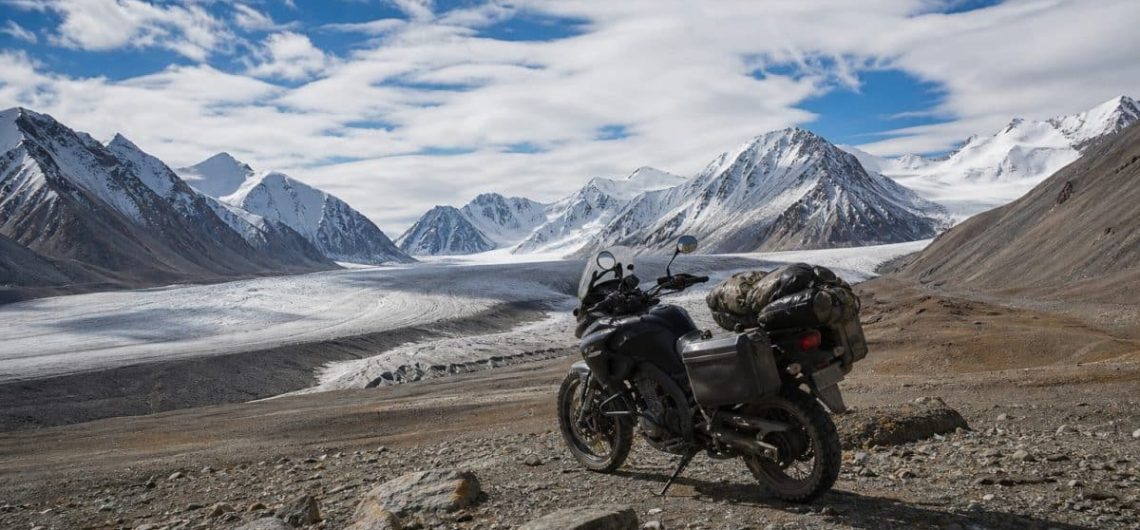
Five sacred peaks, Mongolia’s highest ground and its longest glacier, at the point where four countries almost touch. Getting a motorcycle within sight of it is the far end of the Altai ride, and the last hour is not a road.
The corner where the map runs out
Bayan-Ölgii is Mongolia’s westernmost province, and Altai Tavan Bogd National Park sits at the far western edge of it, hard against the point where Mongolia, Russia and China converge.
The name means the Five Saints, or the Five Holy Peaks, and it refers to the massif at the heart of the park. Khüiten Uul, the tallest of them, is Mongolia’s highest point at a little over four thousand three hundred metres, and it sits directly on the border. Stand at the right place and you are looking at three countries at once.
This is the far end of our Mongolia route and it is what everything before it has been building toward. Ölgii, the Oigor valley rock art, the lakes, and then the ride out toward the peaks.
The glacier
Potanin is Mongolia’s longest glacier, running roughly fourteen kilometres down from the massif, and it is the largest of several in the park.
Seeing it changes the mental picture people have of Mongolia. The country in most imaginations is steppe and desert, dry and brown and horizontal. The Altai is none of those things: it is a high alpine range with permanent ice on it, and the transition from the grassland of the valleys to a wall of glaciated peaks happens over a surprisingly short distance.
You do not ride onto the glacier. Reaching the ice itself requires a multi-day trek from the end of the vehicle track, and that is a mountaineering trip rather than a motorcycle one. What the ride gets you is the approach: the valley floor, the moraine, and the view up to the ice.
That view, with a bike parked in the foreground and nothing else within thirty kilometres, is the photograph people take home.
The last hour is not a road
Worth being clear about what the riding involves out here, because it is the hardest ground on the whole route.
The braided tracks that characterise Mongolian travel get progressively worse as the valleys narrow. What starts as a spread of parallel lines across a wide grassy floor becomes a single line picking through moraine: loose rock, river cobble, sand in the hollows, and gradients that are short but genuinely steep.
There are river crossings, and this far up they are glacier-fed, which means they are freezing and they rise through the day as the sun works on the ice above. A ford that is straightforward at nine in the morning can be a different proposition at four in the afternoon. Morning crossings are not a preference here, they are the plan.
The altitude is a factor too. The valley floors in the park run well over two thousand metres and the tracks climb from there, so the engine is down on power and so are you.
None of it is beyond a competent rider on a suitable bike. All of it rewards riding at seventy percent and none of it rewards ego.
The permits, which are real
This is a border zone and Mongolia treats it as one.
Entry to Altai Tavan Bogd National Park requires a park permit, and travel in the border area additionally requires a border zone permit issued by the authorities in Ölgii. Both need arranging in advance, both are checked, and the checks are conducted by people who are not interested in a good story.
Ascending Khüiten or entering the immediate border strip requires further permissions again, which is a mountaineering matter rather than a riding one.
On a supported trip this is handled before you arrive, which is a large part of what a local operator is for out here. An independent rider turning up in Ölgii and expecting to sort it in an afternoon is going to spend two days on it.
The lakes on the way
The route to the park runs past Khoton and Khurgan, two large freshwater lakes sitting above two thousand metres in a ring of peaks, connected by a short channel.
They are startlingly clear and startlingly cold, they hold fish, and the shoreline is grazing land for the families who move up here in summer. Camping beside one of them, with the temperature dropping fast after sunset and the sky doing what an unpolluted sky at altitude does, is one of the fixtures of this trip.
The birdlife is remarkable and almost nobody comes for it. Bar-headed geese, which migrate over the Himalaya at altitudes that should not be survivable. Whooper swans. Raptors constantly.
Further east and on the way back, Tolbo Lake sits in a bare bowl and turns an improbable blue in the afternoon. It is the last of the water before Ölgii and the road back.
The families who live up here
The park is not empty. Kazakh and Tuvan herding families move into these valleys for the summer with their animals, and the gers you pass are homes rather than exhibits.
The Tuvan communities in the park are a small minority within a minority: Turkic-speaking, historically shamanist and Buddhist rather than Muslim like the surrounding Kazakh population, and connected to the Tuvan republic across the Russian border.
The hospitality convention applies as it does everywhere in Mongolia and it is not optional. If you are invited in, you go in, you take the tea, you sit where you are put, and you accept what is offered with the right hand or with the right hand supported at the elbow. Refusing outright is a real discourtesy in a culture where hospitality to travellers is close to a moral obligation.
What you get in return is an hour inside a felt tent at three thousand metres with a family who will want to know exactly how you got there and why.
The petroglyphs on the way in
The route up runs through the Oigor valley, part of the Petroglyphic Complexes of the Mongolian Altai and a UNESCO World Heritage site.
The carvings on the rock faces there span something like twelve thousand years, from hunting scenes with animals that no longer live in the region, through the arrival of the horse and the wheeled vehicle, to mounted warriors. It is a continuous record of people using the same valley for the entire span of human occupation.
There is no visitor centre, no fence, no ticket. You park on the grass and walk up to the rocks.
Whether that should remain true is a fair question and the answer is probably not, but for now the Oigor valley is one of the last major archaeological sites on earth you can ride a motorcycle to and touch.
Eagle hunters, in season
The Kazakh berkutchi tradition is the thing most people have heard of and it is worth timing if you can.
The birds are female golden eagles, taken as juveniles and trained over months, hunted from horseback in the winter for fox and hare. There are around four hundred registered hunters in the province.
The Golden Eagle Festival takes place in Ölgii in October and it is a genuine competitive event rather than a display, though tourism has certainly found it. Outside that, visits to a hunter’s family are arranged year-round and are, unavoidably, a transaction. That does not make them false; it makes them a livelihood in a province with very few of them.
The season, which is short
June to September and that is the entire list.
Outside that window the passes hold snow, the tracks are mud or ice, and the temperature does things that are dangerous on a motorcycle. Even inside the season this is high continental country: it can snow in July, afternoon storms build over the peaks with little warning, and the daily temperature range in August routinely runs from twenty-five degrees at midday to near freezing at dawn.
What compensates is the daylight. At that latitude in midsummer you have usable light very late, which buys enormous margin when a river is higher than expected or a track turns out not to go through.
Fuel, and why the van matters here
There is no fuel in the park. There is intermittent fuel in the soum centres on the way, of uncertain quality and uncertain availability, and there is proper fuel in Ölgii.
That single fact shapes the whole logistics of the week. A support vehicle carrying jerrycans is not a comfort item on this route, it is what makes the route possible without a series of anxious calculations. The same vehicle carries the tubes, the tools, the water and everybody’s luggage, which means the bikes run light on ground where light matters.
An independent rider doing this needs to be carrying fuel, spares and a satellite communicator, and needs a second bike alongside. It is done and it is a serious undertaking.
Where it sits in the ten days
The route flies from Ulaanbaatar to Ölgii rather than riding the seventeen hundred kilometres of transit, which is the decision that makes a ten-day trip possible at all.
From there: a day up the Oigor valley to the rock art, a day of panorama and the sacred mountain, the Khoton and Khurgan lakes, the waterfall valley and the eagle hunter, then Sagsai and Tolbo Lake on the way back east to Ölgii and the flight home.
Tavan Bogd sits at the far point of that, which is right. You spend three days working out toward it and the rest working back, and the landscape does the thing good routes do, which is build.
The wildlife, which nobody comes for and everybody notices
The Altai supports a set of animals that most visitors do not expect and a few they will not see.
The one you will see constantly is the raptors. Golden eagles, actual wild ones rather than the trained birds, sitting on outcrops and fence posts and lifting off as you pass. Steppe eagles, black kites, upland buzzards. In a landscape this open you spot them at a distance and they are unbothered by a motorcycle.
Marmots stand up beside the tracks like sentries and then dive. Argali sheep, the largest wild sheep in the world with horns to match, live on the higher slopes and are occasionally visible with binoculars. Ibex on the crags.
The snow leopard is up there somewhere and you will not see one. The Altai holds a genuine population and they are among the most effectively invisible large predators on earth. Herders see them, or see what they leave behind among the livestock, which is the source of a long-running conflict that conservation programmes have been trying to defuse with compensation schemes and predator-proof corrals.
There are wolves too, and the same tension applies. In a pastoral economy where a family’s wealth is measured in animals, a predator is not a wildlife spectacle.
Riding a guided tour through this country with a local who can name what you are looking at, and explain why the herders feel about it the way they do, is a different experience from riding through it wondering.
What to expect from the nights
Ger camps and family accommodation, which means a round felt tent with beds in it, a dung stove in the middle and a long-drop somewhere outside. Showers are not a nightly event.
Manage that expectation before booking and the trip is a joy. Arrive expecting a hotel and you will spend a week grumbling. What you get instead is waking up at altitude with nothing but grassland in every direction and a herd of yaks going past the door.
Bring a sleeping bag liner, which weighs nothing and improves every night. Bring layers for the evenings, because the temperature drop after sunset is severe. And bring a head torch, because the electricity is a solar panel and a car battery running one bulb.
What you ride out here
The machine question matters more in the Altai than on any other route we run, and the answer is counterintuitive for anybody who associates adventure travel with large adventure bikes.
Light wins. There is no sustained high-speed running for a big engine to be useful on, and there is a great deal of soft ground, rock and water where forty extra kilograms is a liability. A mid-capacity dual-sport with long-travel suspension, proper dual-purpose rubber, tubed spoked wheels and a seat height you can live with will go everywhere and leave you fresher.
Spoked wheels are not optional: cast wheels crack on this terrain. Handguards, a bashplate and crash protection earn their keep on day one. And the single most valuable modification is the least glamorous, which is not carrying luggage on the bike at all.
That last point is why the support vehicle changes the character of the week. Riding the Altai with a tank bag while the panniers travel in the van is a fundamentally different experience from riding it fully laden, and it is the largest single factor in how much of the trip you enjoy.
Preparing for a route with no shops
A short and specific list, because there is nowhere to buy anything once you leave Ölgii.
On you: layers, because the dawn-to-midday range is enormous. A properly windproof outer, because open ground with nothing to break the wind is colder than the thermometer says. Serious sun protection, because the UV at two thousand metres in dry air is savage and a burnt neck ruins a week. Lip balm. Sunglasses and a clear visor both, because you will ride in glare and then into dust.
In the van: spare tubes in both sizes, levers that are not toys, a pump that works, a filtered fuel funnel, spare fuel and oil filters, cable ties, wire, self-amalgamating tape, spare levers, a spare clutch cable and a torque wrench for everything that vibrates loose.
The item riders most often forget is a sleeping bag liner, which weighs nothing and materially improves every night in a ger. The item they most often over-pack is clothing: you wear riding gear all day and a warm jumper in the evening, and nobody in Bayan-Ölgii cares what you look like.
A satellite communicator is the one piece of safety equipment worth naming individually. Coverage exists around Ölgii and the soum centres and essentially nowhere else, and on a supported motorbike tour the group carries one.
Why the far west rather than the Gobi
The argument in one paragraph, since it is the choice most riders are actually making.
The Gobi is remarkable and it involves enormous distances between things, with riding that is demanding in largely the same way for days on end. The Altai packs glaciated four-thousand-metre peaks, high lakes, twelve thousand years of rock art and a living cultural tradition into an area you can cover in a week, reachable by a three-hour flight at each end.
On a ten-day trip that maths decides it. The difference is between spending your time getting somewhere and spending it there.
Riding western Mongolia for real
Our ten-day Mongolia motorcycle tour starts and ends in Ulaanbaatar with internal flights to Ölgii at each end, then runs the Oigor valley petroglyphs, the Altai panoramas and the sacred mountain, the Khoton and Khurgan lakes, the waterfall valley and a Kazakh eagle hunter, and back east through Sagsai and Tolbo Lake.
Small group, road captain who knows which braid of track actually goes through this season, a local Kazakh tour guide, a mechanic, and a support vehicle carrying fuel, spares and luggage because there is nowhere to buy any of it. Have a look at the 10-day Mongolia Wild West Ride and the tour dates, because the season runs June to September and the departures are few. If you want to line a big biking tour up with the Golden Eagle Festival in October, message us on WhatsApp early: that is the one week a year Ölgii runs out of beds.
 English
 Deutsch
 Español
 Français
 Italiano
Comments