

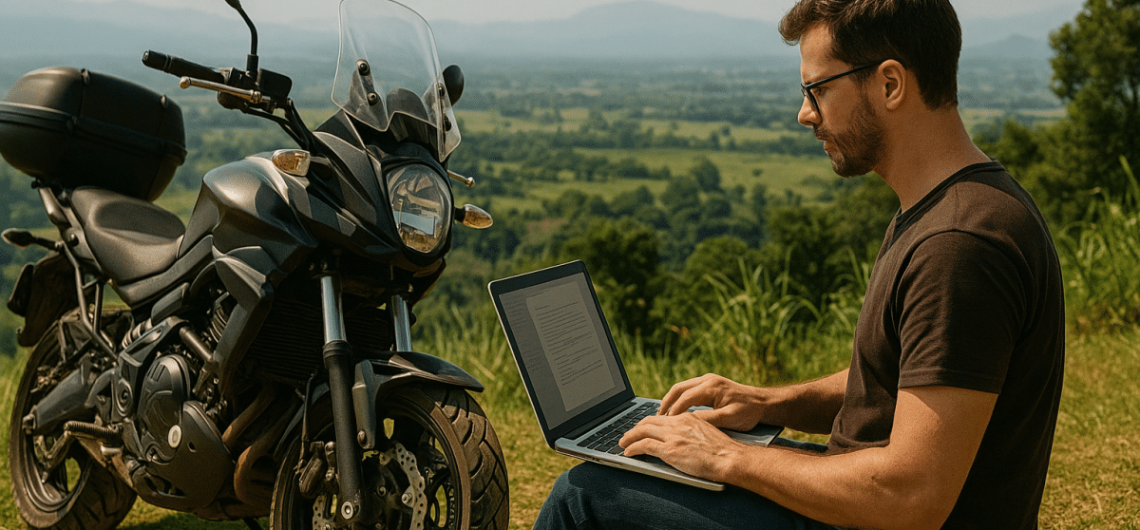
When Your Office Has Two Wheels and 1,864 Curves
Picture this: You’ve just wrapped up a Zoom call from a coworking space in Chiang Mai, closed your laptop, and now you’re strapping on a helmet to conquer some of the most legendary roads in Asia. Your afternoon commute? A guided tour through mountain passes where temples cling to cliffsides and waterfalls appear around every bend. Welcome to the new frontier of remote work, where laptop warriors are trading their standing desks for handlebars and discovering that the best work-life balance might just involve a motorcycle tour through Southeast Asia.
The digital nomad population has exploded past 40 million people worldwide in 2024, and here’s the kicker: Southeast Asia hosts half of the world’s top ten cities favored by remote workers. Bangkok, Chiang Mai, Canggu, and Da Nang aren’t just exotic travel destinations anymore. They’ve transformed into legitimate work hubs where you can close deals in the morning and chase adrenaline in the afternoon. Thailand alone attracts 11 percent of all digital nomads globally, tying with Mexico for the top spot. But unlike Mexico, Thailand offers something truly unique: the chance to combine your remote work lifestyle with world-class motorbike adventure travel on roads that motorcycle magazines drool over.
The Rise of the Laptop-and-Leather Crowd
Let’s talk numbers for a second. About 34 percent of digital nomads rank Southeast Asia as their top destination region, beating out Central America at 16 percent and South America at 13 percent. These aren’t just backpackers on gap years anymore. The average digital nomad pulls in around $50,000 annually, with some high-flyers clearing over a million bucks. They’re software developers, marketers, consultants, and entrepreneurs who’ve figured out that if you can work remote Thailand style, why not do it from a place where your lunch costs three dollars and your weekend involves riding through the Golden Triangle?
Thailand made it even easier in 2024 by launching the Destination Thailand Visa, affectionately known as the DTV. For just $291, you get five years of access to the kingdom with stays up to 180 days at a time. The only catch? You need to show $14,595 in your bank account. Compare that to Portugal’s digital nomad visa or similar programs in Europe, and Thailand suddenly looks like the deal of the century. Countries across Southeast Asia have caught on too. Malaysia rolled out their DE Rantau program, Indonesia launched their Remote Worker Visa, and even Vietnam is making moves to attract the remote work crowd.
Chiang Mai: Where Coworking Spaces Meet Big Bike Tours
Chiang Mai sits in Thailand’s mountainous north like a secret that everybody knows but nobody wants to spoil. This city of 1.2 million people somehow manages to feel intimate despite its size. Digital nomads have been flooding into the Nimman neighborhood and the Old City for years, attracted by the unbeatable combination of fast internet, cheap living, and yes, proximity to some of the best motorcycle roads on the planet. You can rent a decent one-bedroom apartment for $250 to $500 per month. Food runs you anywhere from $140 to $550 monthly depending on whether you’re eating street food or splurging at restaurants. Even at the high end, you’re spending less than half of what you’d drop in Bangkok, let alone San Francisco or London.
But here’s where it gets interesting. Chiang Mai isn’t just a place to park your laptop. It’s ground zero for motorcycle touring in Southeast Asia. Companies like Big Bike Tours have built their entire operation around this city, offering everything from one-day rides to 30-day expeditions across multiple countries. The outfit has been perfecting the art of guided tours since 2002, earning TripAdvisor’s Certificate of Excellence every single year since 2014. They limit groups to 10-12 riders, maintain their fleet to perfection, and employ road captains with certified first aid training. When you’re balancing client calls with curves, that attention to detail matters.
The Mae Hong Son Loop: 1,864 Reasons to Take a Long Lunch
If motorcycle riders had a bucket list, the Mae Hong Son Loop would be scribbled at the top in permanent marker. This 300-kilometer stretch is famous for exactly 1,864 bends of varying sharpness. Let that sink in for a moment. Riders from around the world make pilgrimages to tackle this route, which winds through mountain passes, past hill tribe villages, and along sections so twisty that you’ll forget which way is up. The road connects Chiang Mai to Pai, then on to Mae Hong Son, before looping back through Mae Sariang and Mae Chaem.
The beauty of being a digital nomad in this scenario is flexibility. You don’t need to cram this into a two-week vacation like the tourists do. You can ride the loop over a few days, settle into a hotel with decent wifi in Pai for a week to catch up on work, then continue when you’re ready. Pai itself has become something of a bohemian paradise, filled with cafes where digital nomads tap away at keyboards by day and hit the walking street food markets by night. The town embodies that perfect blend of work and adventure that defines modern motorbike adventure travel.
The Golden Triangle: Where Three Countries and Endless Possibilities Meet
North of Chiang Mai, where Thailand, Laos, and Myanmar converge at the Mekong River, lies the legendary Golden Triangle. This region once ruled the global opium trade but has since transformed into one of Asia’s most spectacular riding destinations. Big biking tour operators like Big Bike Tours have perfected routes through this area that hit all the highlights: the White Temple in Chiang Rai with its surreal white architecture and glittering mirrors, the northernmost point of Thailand at Mae Sai, and the mountain roads to Doi Tung that snake along the Thai-Burma border.
The roads themselves deserve poetry. Route 1148, for instance, consistently ranks among the top ten riding roads in the entire world. When motorcycle magazines need cover shots or journalists want to test new adventure bikes, they come here. The pavement is smooth, the curves are technical without being terrifying, and the scenery shifts from rice paddies to mountain forests to tea plantations so quickly that you’ll want to stop every few kilometers just to take it in. For remote workers who spend most of their time staring at screens, these guided tours offer the kind of sensory overload that makes you remember why you went nomadic in the first place.
Balancing Zoom Calls and Throttle Control
Here’s the honest truth that nobody mentions in those glossy Instagram posts: combining remote work with motorcycle adventures isn’t always easy. You need discipline. You need good time management. And you definitely need to figure out your optimal work conditions before you hit the road. Some digital nomads thrive in bustling cafes with ambient noise and the smell of Thai coffee in the air. Others need silence and rent out coworking spaces with dedicated desks and conference rooms. Chiang Mai offers both in abundance.
Coworking spaces like Heartwork, Alt Chiang Mai, and One Workspace have become second homes for the laptop crowd. Alt Chiang Mai even offers ice baths and breathwork sessions on Wednesday and Friday, because apparently, digital nomads are into that now. Monthly memberships run around $116, giving you 24-hour access, fast internet, and most importantly, a community of people who understand the struggle of joining client calls at 3 AM because your time zones are completely backwards.
The trick is protecting your nights and weekends. When you first go nomadic, there’s a temptation to blur the boundaries between work time and life time. You’ll answer emails at dinner, take calls on Sunday morning, and generally burn yourself out while surrounded by paradise. Successful digital nomads treat their schedules like actual jobs, working normal hours and then shutting the laptop completely. That’s when the motorcycle tour happens. That’s when you ride out to Doi Inthanon, Thailand’s highest peak at 2,565 meters, or explore the back roads that most tourists never see.
The Community Factor: More Than Just Solo Riders
One surprising aspect of this lifestyle is how social it becomes. You’d think combining remote work with motorcycle touring would be isolating, but Southeast Asia has built an entire infrastructure around digital nomads. Chiang Mai alone has dozens of WhatsApp groups where nomads coordinate events, share tips, and organize group rides. Facebook communities connect riders heading in similar directions. Even the guided tour companies foster these connections—Big Bike Tours passengers often stay in touch long after their trips end, planning future adventures together.
The motorcycle element adds another layer to this community. There’s something about sharing a challenging ride that bonds people faster than any coworking space mixer ever could. When you’ve navigated 1,864 curves together, survived a tropical downpour, and celebrated reaching Mae Hong Son with cold beers, you’re not just digital nomad acquaintances anymore. You’re riding partners. And in a lifestyle that can sometimes feel transient and disconnected, those relationships matter.
Women riders have carved out their own space too. Big Bike Tours offers “Women Riders Only” tours with all-female staff, recognizing that not everyone wants to be the only woman in a group of dudes comparing horsepower specs. These tours have exploded in popularity, proving that the combination of remote work and motorbike adventure travel appeals across gender lines.
The Economics of Living Your Dream
Let’s talk money because that’s usually where the dream crashes into reality. Can you actually afford to live in Southeast Asia while working remotely and indulging in regular motorcycle tours? The answer is surprisingly yes, at least if you’re earning that average digital nomad salary of $50,000 per year. In Chiang Mai, you can maintain a comfortable lifestyle for $1,300 to $1,800 per month including rent, food, transportation, coworking space fees, and even the occasional massage. Bangkok costs more, maybe $1,500 to $2,200 monthly, but you’re still looking at expenses well below what you’d face in most Western cities.
The motorcycle tours add up but remain shockable affordable compared to similar adventures elsewhere. Big Bike Tours’ shortest excursions start around $180 for day trips, while their multi-week adventures across multiple countries might run several thousand dollars. But remember, these prices include the bike rental, accommodations, meals, professional guides, support vehicles, and often the kind of experiences that would cost ten times as much in Europe or North America. A five-day guided tour through Northern Thailand covering the Mae Hong Son Loop and Golden Triangle might set you back $1,500 to $2,000, but you’re getting premium service, maintained motorcycles (Honda Africa Twins, BMW GS models, KTM Adventures), and access to roads you’d never find on your own.
The Visa Dance and Tax Confusion
We should address the elephant in the room: visas and taxes. Thailand’s new DTV has simplified things enormously for digital nomads, but it’s not a free-for-all. You’re technically supposed to have health insurance, though enforcement is spotty. And then there’s the tax situation, which as of 2024 remains about as clear as mud. Thailand recently updated their tax code to potentially require tax residents (anyone staying 180+ days annually) to pay income tax on worldwide income, regardless of where it’s earned or when it enters the country. However, enforcement is inconsistent and the rules keep changing.
The smart move? Consult with a local tax advisor before committing to a full year in Thailand. Or structure your stays to remain under that 180-day threshold. Many digital nomads solve this by bouncing between countries—six months in Thailand doing guided tours, a few months in Vietnam or Laos, maybe some time in Malaysia or Indonesia. This strategy keeps you fresh, allows you to explore different motorcycle routes across Southeast Asia, and generally keeps you under the radar of any single country’s tax authority. Plus, it aligns perfectly with the nomadic spirit that brought you here in the first place.
Beyond Thailand: The Broader Southeast Asian Playground
While Thailand rightfully dominates the digital nomad motorcycle conversation, the rest of Southeast Asia offers incredible opportunities too. Big Bike Tours and similar operators run expeditions into Laos, Cambodia, Vietnam, Myanmar, and even Mongolia and Tibet. Vietnam’s Ha Giang Loop has become legendary among riders, though it’s generally more challenging than Thailand’s routes and the infrastructure isn’t quite as dialed in. Laos remains beautifully untouched by mass tourism, offering remote roads where you might not see another vehicle for hours.
What makes Southeast Asia particularly appealing for this lifestyle is proximity. Unlike in the Americas or Europe where crossing borders can mean days of riding, here you can hit multiple countries in a single big biking tour. A 20-day expedition might start in Chiang Mai, cross into Laos, dip into Vietnam, and loop back through Cambodia. Each country offers different flavors of riding, culture, and cuisine, but they’re all accessible without the massive logistics headaches you’d face elsewhere.
The Dark Side: Burning Season and Other Realities
We’d be lying if we painted this lifestyle as nothing but Instagram-perfect moments on mountain roads. Let’s talk about burning season. Every March and April, farmers across northern Thailand and neighboring countries practice slash-and-burn agriculture, turning the entire region into what’s essentially an apocalyptic hellscape of smoke and particulates. The air quality in Chiang Mai during these months ranks among the worst on the planet. You’ll wake up unable to see across the street. Your throat will hurt. That gorgeous mountain view? Gone, replaced by toxic haze.
Experienced digital nomads flee during these months. They head south to Thailand’s islands, escape to Vietnam or Malaysia, or just go home for a while. If your remote work schedule is flexible, this is actually perfect—work intensively during the smoky months when you can’t ride anyway, then take extended time off when the weather clears. But if you’re locked into being in Chiang Mai year-round, those two months will test your commitment to the dream.
Traffic safety is another real concern. Thailand consistently ranks among the most dangerous countries in the world for motorcyclists. The statistics aren’t great. But here’s the thing: those numbers are heavily skewed by locals riding scooters in cities without helmets or experience. When you’re on a properly maintained adventure bike, wearing full gear, riding with professional guides on mountain roads away from urban chaos, your risk profile drops dramatically. That said, accidents happen. Even the best motorcycle tour companies will tell you stories of riders who went down. It’s not a risk-free activity.
The Practical Side: Gear, Bikes, and Getting Started
So you’re sold on the concept. How do you actually make this happen? First, you need to be a competent rider. The companies offering guided tours in Southeast Asia aren’t running kindergarten operations. They expect you to handle your motorcycle in challenging conditions, navigate narrow mountain roads, and generally not panic when things get technical. If you learned to ride last month and have never left the parking lot, maybe start with some experience closer to home.
Most tour operators provide the bikes, gear, and support vehicles. Big Bike Tours, for instance, offers everything from 400cc adventure bikes up to 1100cc BMW GS models and Honda Africa Twins. They provide helmets, though serious riders usually bring their own. You’ll want proper motorcycle gear—mesh jackets work well in Thailand’s heat, and you definitely need real boots, gloves, and pants. Those tourists riding in flip-flops and tank tops? They’re the ones ending up “red raw and bandaged from head to toe,” as one riding guide colorfully put it.
For the work side, your gear is simpler: a reliable laptop, good headphones for calls, and maybe a mobile hotspot as backup. Thailand’s internet is generally excellent, but Murphy’s Law says your wifi will die right before that important client presentation. Having a backup option saves your sanity.
Why This Works: The Psychology of Balance
The real magic of combining remote work with motorbike adventure travel isn’t just about checking boxes on a bucket list. It’s about creating genuine balance in a way that traditional life rarely allows. Most people spend decades dreaming about motorcycle tours through exotic lands, planning to do it “someday” when they retire. Meanwhile, they’re burning out in jobs they tolerate, living for two-week vacations, and watching years slip past.
Digital nomads have hacked this system. Work remote Thailand style, and suddenly “someday” becomes “this weekend.” That motorcycle tour through the Golden Triangle isn’t a once-in-a-lifetime trip you save for years to afford. It’s something you can do multiple times because you’re already here, because your overhead is low, and because you’ve structured your life around these experiences rather than deferring them.
There’s also something about motorcycle riding that complements the digital nomad mindset perfectly. Both require self-reliance. Both demand presence—you can’t ride a technical mountain road while worrying about emails, just like you can’t do good remote work while daydreaming about travel. Both offer freedom within structure. And both communities attract people who’ve decided that conventional paths aren’t the only option.
The Future of This Lifestyle
Where is all this heading? Southeast Asian governments are waking up to the economic potential of digital nomads. These aren’t tourists passing through for a week—they’re high-earning residents spending money consistently over months or years. The introduction of specialized visas across Thailand, Malaysia, Indonesia, and others signals that this lifestyle has moved from fringe to mainstream.
The motorcycle tour industry is evolving too. Big Bike Tours and competitors are expanding routes, upgrading fleets, and professionalizing services to meet demand from this new demographic. Twenty years ago, motorcycle touring in Southeast Asia was strictly for hardcore adventure riders willing to deal with sketchy bikes and nonexistent support. Now you can roll up with zero local knowledge, join a guided tour on a BMW, and have professional mechanics following in a support van. It’s adventure, but with guardrails.
The Asia-Pacific co-living market is projected to grow at 17.9 percent annually through 2025, with much of that growth concentrated in digital nomad hubs like Chiang Mai. These aren’t just apartments—they’re community spaces with coworking facilities, events, and networks specifically designed for remote workers. Some are even adding motorcycle parking and partnering with tour companies to offer integrated experiences. The infrastructure is building itself around this lifestyle.
Your Move: From Dream to Reality
So here’s the question: Are you actually going to do this, or just read about it and go back to your spreadsheets? Because here’s the truth—the barriers are lower than they’ve ever been. Remote work is normalized now. Visa options exist. The community is established. The roads are waiting.
You don’t have to quit everything and buy a one-way ticket tomorrow. Start smaller. Take a two-week trip to Chiang Mai. Book a guided tour with Big Bike Tours or one of their competitors. See if the reality matches the dream. Work from a coworking space for a few days, then hit the Mae Hong Son Loop for a weekend. Test the balance. Figure out if closing your laptop to twist a throttle through 1,864 curves actually delivers the satisfaction you’re imagining.
For many digital nomads, that first motorcycle tour becomes the hook. They plan their work schedules around riding opportunities. They extend visas to catch one more season. They become regulars at local bike shops and watering holes, part of that community of people who’ve chosen this particular blend of work and adventure. Some eventually move on—the nomadic lifestyle by definition involves moving on. But most look back on their time combining remote work with motorcycle touring in Southeast Asia as a defining chapter in their lives.
Ready to Ride Into Your Future?
The digital nomad dream isn’t about escaping work. It’s about reimagining what work can look like when you remove the artificial constraints of location and convention. Southeast Asia, with its combination of affordability, infrastructure, culture, and some of the world’s best motorcycle roads, offers a perfect laboratory for this experiment. Whether you’re chasing the 1,864 curves of the Mae Hong Son Loop, exploring the Golden Triangle’s mountain passes, or creating your own routes through Laos and beyond, you’re participating in something bigger than just a vacation on two wheels.
You’re proving that work and adventure aren’t opposites that need to be balanced against each other. They’re complements that, when woven together thoughtfully, create something richer than either could offer alone. Your office has a view that changes every day. Your commute includes mountain passes and temple stops. Your coworkers are from six continents and your networking happens over Thai food and shared road stories.
Is it for everyone? Absolutely not. Does it require flexibility, adaptability, and a comfort with uncertainty? You bet. But for those who make it work, combining remote work with motorcycle adventures in Southeast Asia isn’t just a lifestyle choice. It’s a radical reimagining of what modern life can be.
Ready to trade your commute for curves and your cubicle for the open road? Visit bigbiketours.com to explore guided tours across Thailand and Southeast Asia. Whether you’re looking for a weekend ride through the Mae Hong Son Loop or a multi-week expedition across five countries, professional guides and perfectly maintained motorcycles are waiting. Your laptop will still be there when you get back—but the experiences you’ll gain on these roads will stick with you forever. Book your adventure today and discover why thousands of digital nomads are choosing to work remote Thailand style, one incredible ride at a time.
 English
 Deutsch
 Español
 Français
 Italiano
Comments