

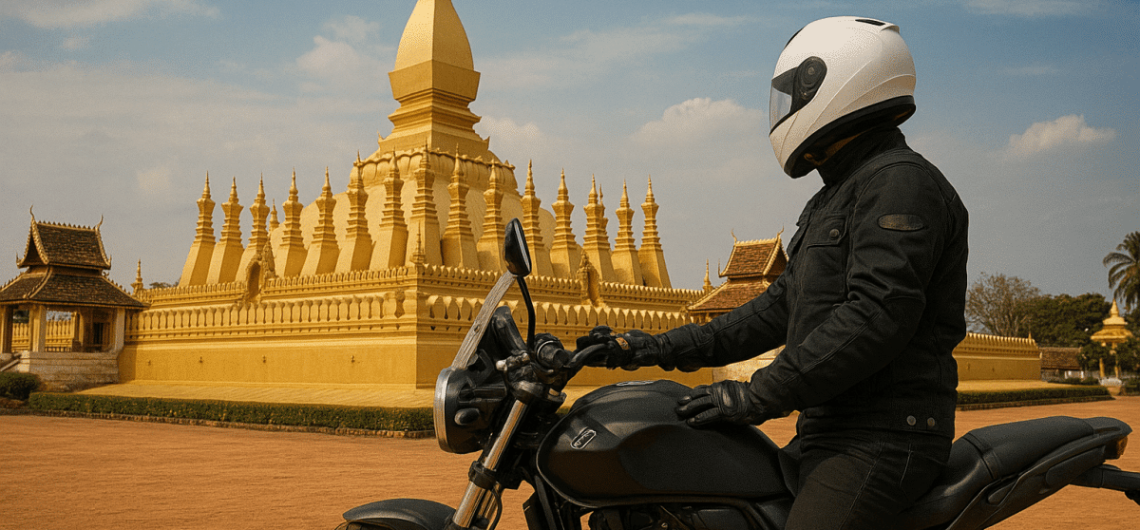
When Thunder Meets Enlightenment
Picture this: you’re cruising along a mountain road at sunrise, the rumble of your engine echoing through misty valleys, when suddenly a golden temple emerges from the clouds ahead like something out of a fever dream. That’s not a hallucination from too much Thai coffee—that’s what happens when you combine a motorcycle tour with Thailand’s ancient Buddhist pilgrimage routes. Who knew spiritual awakening could come with such an incredible soundtrack?
Thailand’s Buddhist heritage isn’t just locked away in museums or dusty textbooks. It’s alive and breathing on the roads that wind through the northern mountains, connecting sacred sites that have drawn pilgrims for over seven centuries. And honestly, there’s no better way to experience this spiritual journey than on two wheels, with the wind in your face and the freedom to stop whenever a golden spire catches your eye. A guided tour through these sacred landscapes transforms a simple motorcycle trip into something that touches your soul—whether you’re religious or just someone who appreciates mind-blowing architecture and incredible views.
The Mountain Temple That Started It All
Let’s talk about Wat Phra That Doi Suthep, because if Thailand’s Buddhist temples were rock bands, this one would be headlining every festival. Perched 1,073 meters above Chiang Mai, this golden wonder has been pulling pilgrims up the mountain since 1383. The legend behind its creation reads like an Indiana Jones script: a monk showed up with a piece of Buddha’s shoulder bone, the king tied it to a white elephant’s back, and the elephant climbed the mountain, trumpeted three times, and dropped dead on the exact spot where the temple now stands. You can’t make this stuff up.
The ride up to Doi Suthep on a motorcycle is an experience that blends adrenaline with anticipation. The road twists and turns through lush jungle, each curve revealing another breathtaking view of Chiang Mai sprawling below. When you finally reach the base, you’ve got two choices: climb the 306 steps flanked by serpent-headed nagas, or take the funicular for those who’d rather save their energy for temple exploration. The golden chedi at the center gleams so bright it’s almost offensive to your sunglasses, and the panoramic view of Chiang Mai from the terrace is worth every switchback you navigated to get there.
What makes this stop essential on any Buddhist motorcycle tour isn’t just the Instagram-worthy architecture—it’s the living, breathing spirituality you’ll encounter. Monks in saffron robes chant their evening prayers while pilgrims walk clockwise around the chedi, following the path of the sun. The air thick with incense smoke and the sound of temple bells creates an atmosphere that makes even the most skeptical traveler pause and reflect. Plus, the ride back down at sunset, with the golden spires glowing behind you, is the kind of moment that makes you understand why people dedicate their lives to big biking tours through Asia.
Where Buddhism Was Born in Thailand
Sukhothai Historical Park is basically Thailand’s spiritual birth certificate written in stone and gold. This UNESCO World Heritage Site sprawls across 70 square kilometers and contains 193 temple ruins that date back to the 13th century when Sukhothai was the first capital of an independent Thai kingdom. Riding through this ancient city feels like traveling through a portal where the modern world just… stops existing for a while. The roads are quiet, the ruins are scattered across parkland dotted with lotus ponds, and everywhere you look, there’s a Buddha statue gazing serenely at you like it’s been expecting your arrival for 700 years.
The centerpiece is Wat Mahathat, the “temple of the great relic,” which features that distinctive lotus-bud shaped chedi that became the signature Sukhothai style. This isn’t your average pile of old rocks—this was the spiritual heart of a kingdom, where kings and commoners alike came to prove their devotion. The main stupa was built in 1345 to house relics of the Buddha, surrounded by smaller stupas arranged in a mandala pattern representing the entire universe. Walking or riding through this complex, especially early in the morning when mist rises from the ponds and catches the first rays of sunlight, you start to understand why this place inspired so much devotion.
What makes Sukhothai perfect for a motorbike tour is that it’s designed for exploration at your own pace. You can rent a bicycle inside the park, but let’s be honest—after riding a big bike through hundreds of kilometers of mountain roads, pedaling feels like a step backwards. The park is divided into five zones, and while the central zone gets most of the attention, the real magic happens when you venture into the less-visited northern and western sections. Here, temple ruins emerge from the jungle with fewer crowds, giving you space to sit quietly and absorb the weight of history without someone’s selfie stick invading your moment of zen.
The Ancient Capital That Refused to Stay Dead
Ayutthaya makes Sukhothai look like a practice run. This was the capital that took the Sukhothai style and said, “Hold my beer,” before building some of the most ambitious religious complexes Southeast Asia had ever seen. Founded around 1350, Ayutthaya grew into one of the world’s most prosperous cities, with over a million residents and trading connections stretching from China to France. Kings competed to build bigger, more elaborate temples, each trying to outdo their predecessor in displays of power and piety.
Then in 1767, the Burmese army showed up and essentially rage-quit the city’s existence, destroying everything they could before burning it all down. What remains today is hauntingly beautiful—headless Buddha statues, crumbling prangs pointing at the sky like accusing fingers, and the famous Buddha head wrapped in tree roots at Wat Mahathat that’s become Thailand’s most recognizable archaeological image. Riding a motorcycle through Ayutthaya’s ruins feels like exploring a post-apocalyptic movie set, except instead of zombies, you’ve got locals selling coconut ice cream and offering boat tours around the island.
The UNESCO-protected historical park contains 67 temple ruins spread across an island where three rivers converge. A guided tour helps you understand what you’re looking at—without context, it’s easy to see just a bunch of brick towers and miss the incredible stories they tell. Wat Phra Si Sanphet, with its three distinctive chedis, was the royal temple that inspired Bangkok’s famous Wat Phra Kaew. Wat Chaiwatthanaram, sitting dramatically on the riverside, showcases the Khmer-influenced architecture that Ayutthaya’s kings borrowed and improved upon. Each ruin whispers tales of a cosmopolitan city that once welcomed Japanese samurai, Portuguese missionaries, and Persian traders, all mixing together in Southeast Asia’s most international metropolis.
The Loop That’ll Loop You Into Another Dimension
No discussion of Buddhist pilgrimage routes on a motorcycle in Thailand would be complete without mentioning the Mae Hong Son Loop—the 600-kilometer circuit that many riders consider the best biking adventure in all of Southeast Asia. This route isn’t officially a Buddhist pilgrimage, but it connects so many temples, hilltribe villages, and sacred sites that it might as well be. Plus, with 1,864 curves winding through mountains near the Burmese border, it’s the kind of ride that naturally makes you contemplate the impermanence of existence—especially when you’re leaning into turn number 437.
The loop traditionally starts and ends in Chiang Mai, taking you through places like Pai, Mae Hong Son, and back through Mae Sariang. Along the way, you’ll encounter hill tribes like the Karen people with their famous long-necked women, hot springs perfect for soaking sore muscles after a long day of riding, and countless small temples perched in locations that make you wonder how the monks even got the building materials up there. Each motorbike tour operator has their own variation of the route, but the essence remains the same: spectacular mountain scenery, challenging roads, and enough cultural immersion to give you perspective on how the other 99% of Thailand lives.
What makes the Mae Hong Son Loop special for Buddhist pilgrimage isn’t any single temple along the way—it’s the cumulative effect of riding through a region where Buddhism is woven into the fabric of daily life. You’ll see monks collecting alms at dawn in tiny villages, stumble upon forest temples where meditation retreats happen in near-total isolation, and find yourself invited to local festivals where ancient animist traditions blend seamlessly with Buddhist practices. This is where you realize that Buddhism in Thailand isn’t just about the famous temples tourists photograph—it’s a living tradition that shapes everything from how people greet each other to how they view death and rebirth.
The White Temple That Broke All the Rules
Wat Rong Khun, better known as the White Temple in Chiang Rai, is what happens when a contemporary artist decides to build a Buddhist temple that looks like it fell out of a surrealist painting. Created by Chalermchai Kositpipat starting in 1997, this all-white structure covered in mirror fragments is either the most beautiful or the most bizarre temple you’ll ever see, depending on whether you’ve had your morning coffee yet. The symbolism is intense: the white represents Buddha’s purity, the mirrors symbolize wisdom, and to reach the main hall, you must cross a bridge over hundreds of outstretched hands representing human desire and suffering.
Inside, things get even weirder. The murals feature everything from traditional Buddhist imagery to contemporary pop culture icons—we’re talking Spider-Man, Neo from The Matrix, and even depictions of 9/11. It’s like someone took Buddhist philosophy, mixed it with modern anxiety about technology and global events, and decided to paint the whole thing on temple walls. Some traditional Buddhists think it’s sacrilegious; others see it as a brilliant commentary on how ancient teachings apply to modern life. Either way, it’s absolutely not boring, and it makes for one of the most photographed stops on any motorcycle tour through northern Thailand.
The ride to the White Temple from Chiang Mai takes you through changing landscapes, from rice paddies to mountain foothills, passing through towns where life moves at a pace that makes even the countryside seem rushed. What makes this stop fit perfectly into a Buddhist pilgrimage route is that it forces you to reconsider what a “sacred site” even means. Can something built in the 21st century with contemporary art references be as spiritually significant as an 800-year-old temple? Spoiler alert: when you’re standing there watching Thai pilgrims pray with the same devotion they show at ancient sites, you realize that spirituality isn’t about age—it’s about intention and meaning.
Why the Journey Matters More Than the Destination
Here’s the thing about combining Buddhist pilgrimage with a guided motorcycle tour: Buddhism has always been about the journey, not the destination. The Buddha himself walked everywhere, teaching along roads and under trees, believing that enlightenment comes through experience, not from sitting in one place reading about it. When you’re on a motorcycle, covering hundreds of kilometers through varied terrain, stopping at temples that range from ancient ruins to contemporary masterpieces, you’re actually living one of Buddhism’s core principles—that wisdom comes from direct experience of the world.
A big bike tour through Thailand’s Buddhist heartland isn’t like a packaged tourist experience where someone else decides what you should see and when. Sure, you’ve got a guide who knows the roads and can explain the history, but between those stops, you’re free to follow your curiosity. That random temple you spot from the road? Pull over and check it out. The local festival that’s blocking the main route? Excellent—now you get to participate instead of just observing. The monk who waves you over to share tea? That’s going to be a conversation you remember longer than the specs on Ayutthaya’s biggest prang.
The beauty of exploring spiritual sites on a motorbike is that the vehicle itself becomes a meditation tool. You can’t text, can’t scroll social media, can’t really do anything except be present in the moment, reading the road, feeling the bike respond to your movements, watching the landscape transform as you climb from tropical lowlands into cooler mountain regions. It’s the closest thing to active meditation most of us will ever experience, especially when you’re riding through the early morning mist with nothing but the sound of your engine and distant temple bells for company.
The Practical Magic of Buddhist Motorcycle Touring
Let’s address the elephant in the temple—or rather, the motorcycle on the mountain road. Companies like Big Bike Tours have turned Buddhist pilgrimage routes into accessible adventures for riders of all skill levels. These aren’t hardcore off-road expeditions where you’re expected to fix your own bike with bamboo and determination. These are well-maintained motorcycles, comfortable accommodations, and experienced guides who know every curve, every temple, and every noodle stall worth stopping at along the way.
A typical guided tour might run anywhere from five days for a northern Thailand loop to three weeks for an epic journey that includes Laos and Vietnam. The routes are carefully planned to hit the major Buddhist sites while avoiding the worst traffic and including enough challenging roads to keep experienced riders engaged. You’ll ride well-maintained bikes—usually something comfortable like a BMW or Honda—with support vehicles carrying your luggage and ready to help if anything goes wrong. It’s the perfect balance between adventure and accessibility, letting you focus on the experience rather than worrying about where you’ll sleep or whether your bike’s going to leave you stranded in the jungle.
The best motorcycle tours happen during the cooler months from November to February, when Thailand’s weather cooperates with perfect riding conditions—clear skies, minimal rain, and temperatures that don’t turn your helmet into a portable sauna. This is also when many of Thailand’s most important Buddhist festivals take place, adding another layer of cultural immersion to your journey. Imagine arriving at a temple just as Loy Krathong is being celebrated, with thousands of floating lanterns rising into the sky while monks chant evening prayers. That’s not something you can schedule—it’s the kind of magic that happens when you’re out there, following the roads wherever they lead.
When Your Spiritual Journey Needs Two Wheels and an Engine
Buddhism teaches that all beings seek happiness and wish to avoid suffering, which sounds nice until you realize it means spending your vacation visiting sacred sites instead of just lying on a beach somewhere. But here’s the secret they don’t tell you in the meditation apps: the path to contentment doesn’t have to be solemn and serious. It can involve incredible food, stunning scenery, the thrill of perfect curves on mountain roads, and the kind of profound moments that sneak up on you when you’re not expecting them—like when you’re sitting on a temple terrace at sunset, still feeling the vibration of the day’s ride in your bones, watching the golden light paint ancient stones while monks chant in the distance.
A Buddhist motorcycle tour through Thailand offers something that walking pilgrimages can’t match: the ability to cover vast distances, connecting sacred sites separated by hundreds of kilometers, experiencing the full diversity of Thailand’s spiritual landscape in a single journey. You can start your day at a bustling temple in Chiang Mai, ride through mountain villages where Buddhism blends with animist traditions, stop for lunch at a monastery where monks will invite you to eat with them, and end your evening at a remote forest temple where the only sounds are cicadas and wind chimes. That range of experience—that’s what makes this type of pilgrimage special.
Thailand hosts more than 44,000 Buddhist temples, ranging from the grand UNESCO World Heritage Sites that draw millions of visitors to tiny rural shrines that see maybe a dozen pilgrims per year. A motorbike tour lets you experience both ends of that spectrum, understanding how Buddhism adapts to different contexts while maintaining its core teachings about compassion, mindfulness, and the path to enlightenment. Whether you’re religious, spiritual-but-not-religious, or just someone who appreciates incredible architecture and the chance to see a country from perspectives tourists rarely get, these sacred routes offer something valuable.
Rolling Toward Your Own Enlightenment
The Buddha taught that clinging to things causes suffering, which creates an interesting paradox for travel writers: how do you describe experiences without making people desperately want to cling to them? But maybe that’s the point. A Buddhist pilgrimage on a motorcycle through Thailand isn’t about acquiring experiences to add to your collection like Pokemon cards. It’s about opening yourself to whatever each moment offers—the good rides, the challenging ones, the temples that move you, the ones that don’t, the strangers who become friends, the quiet moments alone with your thoughts on a mountain road.
These sacred routes through Thailand’s spiritual heart have been drawing seekers for centuries, and they’ll continue long after we’re all dust. The temples will still stand (mostly), the mountains will still challenge riders, and the Buddhist teachings carved in stone and taught by monks will still offer their timeless wisdom about impermanence, compassion, and the nature of existence. The only question is whether you’ll experience them from behind a bus window or from the seat of a motorcycle, fully immersed in every sense—the smell of incense and jasmine, the sound of temple bells and engine notes, the feeling of morning mist and afternoon sun, the taste of street food eaten with monks who laugh at your attempts to use chopsticks.
Modern Buddhism has adapted to contemporary life in countless ways, from meditation apps to mindfulness courses in corporate settings. But there’s something irreplaceable about experiencing it in the landscape where it took root and flourished, following routes that pilgrims have traveled for centuries, even if you’re doing it at 80 kilometers per hour on a motorcycle instead of walking barefoot like they did. The form changes, but the essence remains: the journey itself as teacher, the road as meditation, and the destination as just another point along an endless path of discovery.
Ready to trade your meditation cushion for a motorcycle seat? Big Bike Tours specializes in guided spiritual journeys through Thailand’s Buddhist heartland, combining the thrill of world-class riding with deep cultural immersion at sacred sites most tourists never see. Whether you’re an experienced rider seeking enlightenment at high speeds or a beginner ready to discover Thailand’s spiritual side on two wheels, these carefully crafted tours offer the perfect balance of adventure, comfort, and profound cultural connection. Visit bigbiketours.com to explore routes that connect ancient temples, UNESCO heritage sites, and living Buddhist traditions—because sometimes the best path to peace runs through a few thousand curves in the Thai mountains. Book your Buddhist motorcycle tour today and discover that the journey really is more important than the destination, especially when the journey involves stunning scenery, incredible food, and the freedom of the open road.
 English
 Deutsch
 Español
 Français
 Italiano
Comments